In this article:
- What does it mean to sell your house for cash?
- Why homeowners choose to sell for cash
- How to sell your house for cash: step-by-step process
- Cash home sale timeline: how long does it really take?
- Cash offer vs. traditional sale: a complete comparison
- How to find legitimate cash home buyers
- Can you sell a house as-is for cash?
- What is an iBuyer cash offer?
- How to sell a house for cash fast: 5 speed tips
- FAQs about selling your house for cash
Get an offer with a click of a button!
Sell your home directly to Opendoor, so you can skip all the hassle and months of uncertainty. Simply enter your address – and get our offer with a few simple steps.
What Does It Mean to Sell Your House for Cash?
Cash buyers now represent a significant share of the housing market. According to the National Association of Realtors (NAR), all-cash transactions accounted for roughly 26% of existing-home sales in 2024 — and that figure has continued climbing into 2025.
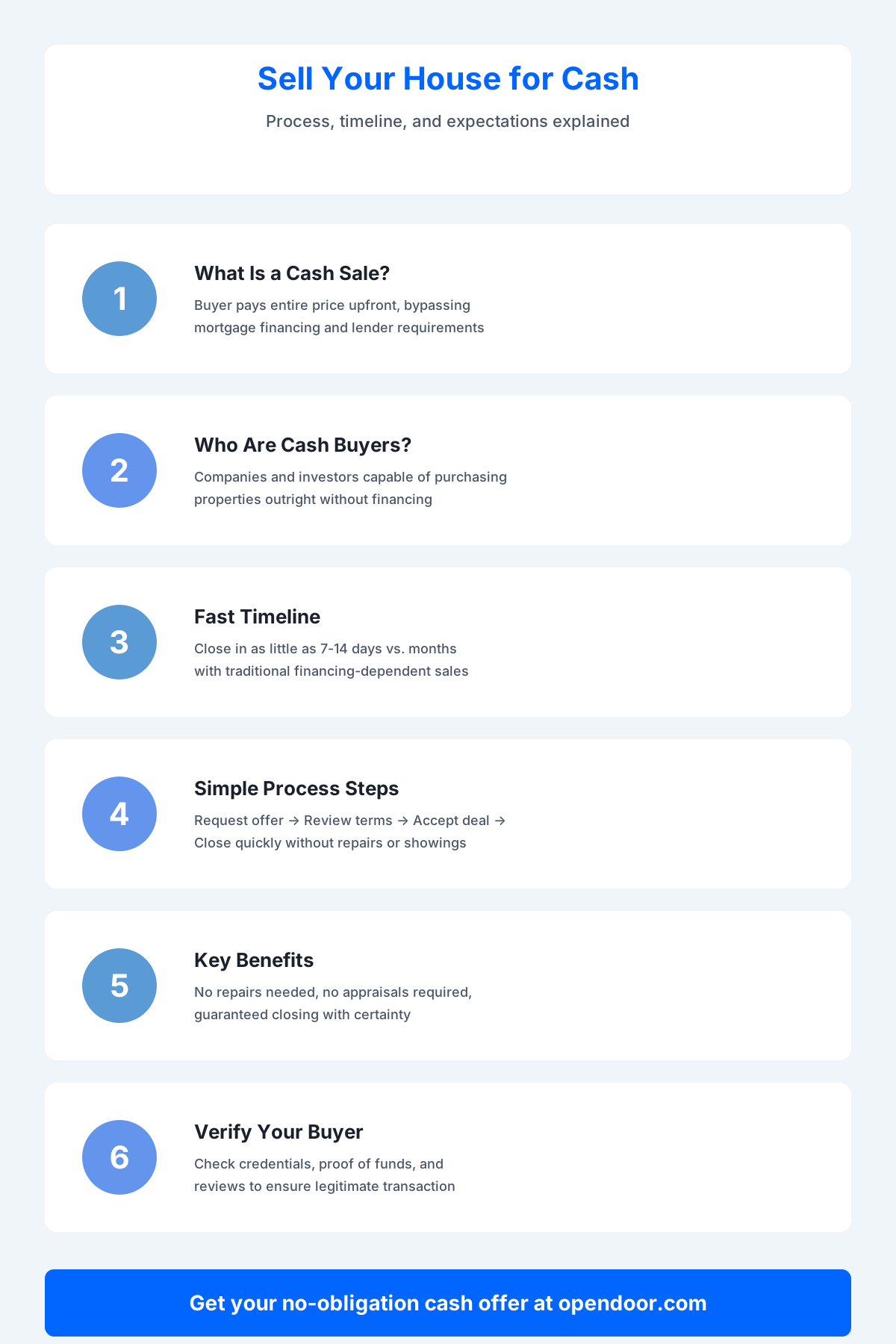
Selling your house for cash means accepting an offer from a buyer who pays the full purchase price without relying on mortgage financing. Because there is no lender involved, the transaction skips the loan application, underwriting, and lender-required appraisal steps that define a traditional sale. The result is a faster, simpler closing process with far fewer contingencies.
Cash buyers can be individuals, real estate investors, "we buy houses" companies, or technology-enabled iBuyers like Opendoor. While each type operates differently, they all share one thing in common: funds are verified and available upfront, which dramatically reduces the risk of a deal falling through.
If you're weighing your options, it helps to first understand what a cash offer in real estate actually involves before diving into the process.
Related: what is a cash offer in real estate.
Why Homeowners Choose to Sell for Cash
Not every seller prioritizes getting the highest possible list price. In many situations, speed, certainty, and convenience matter just as much — or more. Here are the most common reasons homeowners choose cash offers:
- Speed: Cash sales close in as few as 7–14 days compared to 45–90 days for a traditional financed sale. If you need to sell your house fast, a cash buyer is often the most direct path.
- Certainty of close: Roughly one in six traditional home sales experiences delays or cancellations due to financing issues, per NAR data. Cash eliminates that risk entirely.
- Sell as-is: Most cash buyers purchase properties in their current condition, saving sellers thousands in pre-listing repairs.
- No showings or staging: You skip the disruption of open houses, weekend showings, and the pressure to keep a home in "show-ready" condition.
- Simplified paperwork: Without lender requirements, the documentation burden drops significantly.
- Life transitions: Divorce, job relocation, inherited property, or financial hardship often create urgency that the traditional market can't accommodate.
Understanding how much it costs to sell a house through traditional channels puts the convenience of a cash sale into sharper financial context.
Related: Opendoor cash offer.
How to Sell Your House for Cash: Step-by-Step Process
The cash home sale process is streamlined compared to a traditional listing, but the specific steps and timeline vary depending on the type of buyer. Below is a step-by-step breakdown with approximate day ranges.
Step 1: Determine Your Home's Market Value (Day 1)
Before entertaining any offers, know what your property is worth. This protects you from lowball offers and gives you a baseline for negotiations.
- Use an online valuation tool. Opendoor and other platforms provide instant preliminary estimates. You can also explore steps to find out what your home is worth.
- Check comparable sales (comps). Look at recently sold homes in your area with similar size, age, and condition.
- Consider a pre-listing appraisal. For $300–$500, a licensed appraiser can give you an independent value opinion — particularly useful if you suspect your home's condition may affect pricing.
Step 2: Research and Request Cash Offers (Days 1–5)
Don't accept the first offer you receive. Request multiple cash offers from different buyer types so you can compare terms, fees, and timelines.
- iBuyers like Opendoor let you request an offer online in minutes.
- Local real estate investors can often be found through networking, local real estate investment associations, or direct-mail campaigns.
- "We buy houses" companies typically respond within 24–48 hours with a preliminary offer.
Getting multiple bids is the single most effective way to ensure you're getting a fair price. See our full guide on how to find legitimate cash home buyers below.
Step 3: Review and Compare Offers (Days 3–7)
When cash offers start coming in, resist the urge to focus only on the headline number. Evaluate each offer across these dimensions:
- Net proceeds: What will you actually walk away with after fees, service charges, and closing costs?
- Contingencies: Does the buyer require an inspection, appraisal, or any other conditions?
- Timeline: When does the buyer propose to close? Can you choose your move-out date?
- Fees and commissions: iBuyers charge service fees (typically 5–6%), while investors may charge nothing upfront but offer a lower price.
- Flexibility: Can you negotiate a rent-back period if you need extra time to move?
Understanding closing costs for sellers is critical for calculating your true bottom line.
Step 4: Accept an Offer and Open Escrow (Days 5–10)
Once you accept a cash offer, the buyer deposits earnest money into an escrow account and a title company begins the title search. In a cash transaction, escrow is typically shorter and simpler because there's no lender involved.
During this phase:
- A purchase agreement is signed by both parties.
- The title company verifies that the property has a clean title and no outstanding liens.
- The buyer provides proof of funds (a bank statement or verification letter).
Your property is now under contract.
Step 5: Complete the Inspection (If Applicable) (Days 7–14)
Not all cash buyers require inspections, but many do — and it's often in everyone's interest.
- iBuyers (like Opendoor) typically conduct a home assessment, either in person or virtually, to verify property condition. Any condition-related adjustments to the offer price happen at this stage.
- Investors and "we buy houses" companies frequently waive inspections entirely, especially for distressed properties.
- Individual cash buyers may request a standard home inspection similar to a financed sale.
If you're curious about what gets evaluated, review this home inspection overview.
Step 6: Close and Get Paid (Days 10–30)
Closing on a cash sale is faster because there is no mortgage underwriting, no lender-required appraisal, and no financing fall-through risk. Here's what to expect:
- Closing documents are significantly thinner — no loan disclosures, no lender conditions.
- Closing day involves signing the deed, settlement statement, and any required state disclosures at a title company or attorney's office.
- Funds transfer typically happens via wire on the same day or within 24 hours of closing.
For more detail on what the final steps look like, see our guides on the closing process for sellers and how long closing takes.
Documents you need to sell your house for cash
Cash sales close faster, but they don't skip paperwork — they just compress it. Having the right documents ready before you accept an offer is the single biggest predictor of whether you close in 14 days or 45 days. The list below covers what almost every cash buyer (investor, we-buy-houses operator, or iBuyer-style program like Opendoor) will ask for.
The core documents to gather before you list or request an offer:
- Government-issued ID for every titled owner. Required for the closing notary; expired IDs cause same-day delays.
- Property deed. Confirms current ownership and legal description.
- Mortgage payoff statement. Order this from your lender; payoff quotes are usually valid for 10-30 days, so time the request to your closing date.
- Most recent property-tax statement. Used by the title company for prorations.
- HOA documents (if applicable). CC&Rs, current dues, special assessments, and the HOA contact for the estoppel letter.
- Utility records for the last 12 months. Some cash buyers ask for these to validate operating costs; not always required.
- Permits for renovations. If you've added square footage, finished a basement, or converted a garage, have permit records ready.
- Survey of the property. Optional but speeds title work if available.
- Seller's property disclosure. Even cash buyers in as-is transactions typically require the state-mandated disclosure form.
- Closing documents (delivered at signing). Provided by the title company or attorney; you'll review and e-sign these in the final week.
If any of these are missing — particularly the payoff statement or HOA documents — the closing timeline shifts. Order them when you accept the offer, not the week of closing. For the Opendoor-specific document flow, see What financial documents do I need? and What happens after I sign the contract?.
Cash Home Sale Timeline: How Long Does It Really Take?
One of the biggest advantages of selling for cash is speed — but exactly how fast depends on the buyer type and your specific situation. Here's a phase-by-phase comparison.
Cash Sale vs. Traditional Sale: Timeline Comparison
| Phase | Cash Sale | Traditional Sale |
|---|---|---|
| Listing and marketing | Not required | 1–4 weeks (photos, staging, showings) |
| Receiving an offer | 1–7 days | 2–8 weeks (varies by market) |
| Inspection | 0–7 days (often waived) | 7–14 days |
| Appraisal | Not required | 1–3 weeks |
| Mortgage underwriting | Not required | 3–6 weeks |
| Closing | 7–14 days from accepted offer | 30–45 days from accepted offer |
| Total estimated time | 7–30 days | 45–90+ days |
Sources: National Association of Realtors 2024 Profile of Home Buyers and Sellers; ICE Mortgage Technology Origination Insight Report
Timeline by Cash Buyer Type
- iBuyers (e.g., Opendoor): 21–30 days on average. The online offer process is fast (often same-day), but a virtual or in-person assessment adds a few days. Closing is scheduled at your convenience.
- Real estate investors / flippers: 7–21 days. Experienced investors move quickly, though timelines depend on title work and local requirements.
- "We buy houses" companies: 7–14 days. These companies prioritize speed above all else and often handle closing logistics in-house.
- Individual cash buyers: 14–30 days. While there's no lender delay, individual buyers may need time for inspections, attorney review, or personal logistics.
Understanding why days on market matter can help you appreciate the compounding costs of a slower traditional sale — from mortgage payments and utility bills to property taxes and maintenance.
Related: how long does closing take.
Cash Offer vs. Traditional Sale: A Complete Comparison
Choosing between a cash offer and a traditional sale is one of the most consequential decisions a homeowner can make. Here's a side-by-side breakdown of how they compare across every major factor.
Comparison Table
| Factor | Cash Offer | Traditional Sale |
|---|---|---|
| Timeline to close | 7–30 days | 45–90+ days |
| Certainty of close | Very high (no financing contingency) | Moderate (deals fall through in ~15% of cases) |
| Sale price | Typically 5–15% below full market value | Full market value (or above in competitive markets) |
| Agent commissions | Usually none (especially with iBuyers/investors) | Typically 5–6% of sale price |
| Repair costs | $0 in most cases (sold as-is) | $5,000–$15,000+ average for pre-listing repairs |
| Appraisal required | No | Yes (lender requirement) |
| Contingencies | Minimal or none | Inspection, appraisal, financing, sale of buyer's home |
| Showings / open houses | None | Multiple, often over weeks |
| Stress level | Low | Moderate to high |
When a Cash Offer Makes More Sense
- You need to sell quickly due to relocation, divorce, financial hardship, or foreclosure risk.
- Your home needs significant repairs and you can't afford (or don't want) to invest in them before selling.
- You've inherited a property you don't want to manage or maintain long-distance.
- You want certainty and can't afford the risk of a deal falling through.
- Your local market favors buyers, making a quick, guaranteed sale more attractive than a prolonged listing.
When Listing Traditionally Wins
- You want maximum sale price and your home is in good condition in a seller's market.
- You have time — no pressing deadline means you can wait for the best offer.
- Your home has unique features (waterfront, historic, luxury) that command premium pricing through competitive bidding.
The Price Gap Is Often Smaller Than You Think
Cash offers are typically quoted at 5–15% below full market value. But sellers often overlook the costs embedded in a traditional sale that shrink the gap:
- Agent commissions: 5–6% of the sale price (learn how agent commissions work)
- Pre-listing repairs and staging: $5,000–$15,000 on average
- Carrying costs during the listing period: Mortgage payments, property taxes, insurance, and utilities for 2–3+ months
- Seller concessions: Buyers in traditional sales often negotiate concessions worth 1–3% of the price
When you subtract these costs from a traditional sale's gross price, the net proceeds from a competitive cash offer are often surprisingly close.
For a deeper dive, see how selling to Opendoor compares to a traditional home sale.
Related: how Opendoor differs from a traditional sale.
What your cash offer net proceeds actually look like
Headline price tells you almost nothing about what you walk away with. To compare a cash offer against a traditional sale honestly, build a net-proceeds calculation that accounts for service charges, commissions, repair concessions, holding costs, and the time-value of closing 30-60 days sooner. The example below shows how those numbers stack up on a $400,000 home in a typical market.
The traditional-sale path on a $400K home:
- Sale price: $400,000 (assumes 30+ days on market)
- Agent commissions (5-6%): -$20,000 to -$24,000
- Seller-paid closing costs (1-3%): -$4,000 to -$12,000
- Pre-listing repairs and prep: -$5,000 to -$15,000
- Inspection-driven repair credits: -$2,000 to -$10,000
- Mortgage interest, taxes, utilities during 30-60 day listing window: -$2,000 to -$5,000
- Net at closing: ~$334,000 to ~$367,000 (with downside risk of buyer financing falling through)
The cash-offer path on the same $400K home:
- Cash offer price: typically slightly below market (5-15% lower for investors; closer to market for iBuyer-style programs like Opendoor)
- Service charge (Opendoor): Shown in the offer breakdown; replaces traditional agent commissions
- Seller-paid closing costs: Generally standard, but no agent commission and often no buyer-side concessions
- Pre-listing repairs: $0 (Opendoor handles repairs after closing)
- Inspection-driven repair credits: $0 (Opendoor's price is what you net, less standard closing items)
- Holding costs: Minimal (close in 21-60 days)
- Net at closing: Often within a few percentage points of the traditional-sale net, depending on how much repair work the home needs
The right comparison isn't list price vs cash price — it's expected traditional net vs certain cash net, with the cash route trading some upside price for certainty and speed. Opendoor publishes the service charge and pricing inside the offer breakdown, and you can cancel any time before closing at no cost if the traditional listing route ends up looking better.
How to Find Legitimate Cash Home Buyers
Not all cash buyers are created equal. Understanding who you're dealing with — and how to vet them — is essential to getting a fair deal and avoiding predatory practices. Here are the main types of cash home buyers, along with their pros and cons.
Types of Cash Buyers
1. iBuyers (e.g., Opendoor)
- How they work: Technology-driven companies that use automated valuation models to make near-instant offers on homes. The process is transparent, online, and seller-friendly.
- Typical offer range: Close to market value minus a service fee (usually 5–6%).
- Pros: Transparent pricing, flexible closing dates, professional process, strong consumer protections.
- Cons: Not available in all markets; service fees apply; property must meet eligibility criteria.
2. Real Estate Investors / House Flippers
- How they work: Buy properties below market value, renovate them, and resell for a profit.
- Typical offer range: 60–80% of after-repair value.
- Pros: Fast close, will buy distressed properties, experienced with complex transactions.
- Cons: Negotiate aggressively on price; variable professionalism; less standardized process.
3. "We Buy Houses" Companies
- How they work: National and local companies that purchase homes quickly, often with minimal paperwork. They target sellers who prioritize speed and convenience.
- Typical offer range: 50–70% of market value.
- Pros: Fastest closings (sometimes under 7 days), minimal requirements, buy virtually any property.
- Cons: Lowest offers of any cash buyer type; highest risk of pressure tactics; some operate as scams.
4. Individual Cash Buyers
- How they work: Private individuals (often retirees, relocators, or downsizers) who purchase with personal funds.
- Typical offer range: Close to market value.
- Pros: May pay near full price; no intermediary fees.
- Cons: Rare outside luxury markets; process can be less predictable; may still request inspections and extended timelines.
Red Flags to Watch For
Be cautious of any cash buyer who:
- Refuses to provide proof of funds before you sign anything.
- Pressures you to sign immediately or creates artificial urgency.
- Charges upfront fees before an offer is made.
- Won't put the offer in writing or uses vague contract language.
- Has no verifiable online presence, reviews, or business registration.
- Asks you to sign over the deed before closing through a title company.
How to Vet a Cash Buyer
- ✅ Request proof of funds: A bank statement or letter from a financial institution verifying liquid assets.
- ✅ Check BBB ratings and reviews: Look on the Better Business Bureau, Google, and Trustpilot.
- ✅ Verify business registration: Confirm the company is registered in your state.
- ✅ Read the contract carefully: Look for hidden fees, assignment clauses, or inspection-contingency loopholes.
- ✅ Hire a real estate attorney: Even if you're selling without a realtor, a brief attorney review of the purchase agreement ($200–$500) can prevent costly mistakes.
Tax implications of a cash home sale
Selling for cash doesn't change how the IRS treats your sale; a cash transaction and a financed transaction are taxed the same way. What matters is how long you've owned the home, whether it's your primary residence, and how much you've gained over your adjusted cost basis. The mechanics are the same as any other home sale.
The two main tax frameworks to know:
- Section 121 primary-residence exclusion. If you've owned and lived in the home as your primary residence for at least 2 of the last 5 years, you can exclude up to $250,000 of gain ($500,000 for married filing jointly) from federal capital gains tax. This is the most powerful tax break in residential real estate, and it doesn't care whether the sale was cash or financed.
- Capital gains on the rest. Gain above the exclusion (or the entire gain if the home isn't your primary residence) is taxed at long-term capital-gains rates (0%, 15%, or 20% federal) if you've held the home more than a year, and at short-term ordinary income rates if held less than a year.
A few situations where the math gets more complex:
- Investment property sale. No Section 121 exclusion. Consider whether a 1031 like-kind exchange into another investment property defers the gain — but 1031 has strict timing rules (45 days to identify, 180 days to close) and doesn't apply to a primary residence.
- Inherited home. The cost basis steps up to the fair market value on the date of death, which often eliminates most of the gain when you sell.
- Home with depreciation taken (rental or home office). Depreciation recapture is taxed at up to 25% even if Section 121 covers the rest.
- State capital-gains tax. Most states tax capital gains as regular income; a few (Florida, Texas, Nevada, Washington, etc.) have no state income tax.
The IRS publishes detailed guidance in Publication 523: Selling Your Home. Talk to a tax professional before closing if any of the above edge cases apply — adjusting basis or timing the sale into a different tax year can change the bill meaningfully.
Can You Sell a House As-Is for Cash?
Yes — and it's one of the primary advantages of working with a cash buyer. Selling as-is means you're offering the property in its current condition with no obligation to make repairs before closing.
What "As-Is" Means Legally
When you list a property as-is, you're signaling to buyers that you will not negotiate repair credits or complete fixes based on inspection findings. The buyer accepts the home's condition at the time of sale.
However, as-is does not mean "no disclosures." In most states, sellers are still legally required to disclose known material defects — things like foundation issues, water damage history, lead paint (for pre-1978 homes), or roof leaks. Failure to disclose known issues can expose you to legal liability even in an as-is transaction.
Which Cash Buyers Accept As-Is Properties?
Virtually all of them:
- iBuyers purchase as-is but may adjust the offer price after a home assessment to account for needed repairs.
- Investors and flippers actively seek as-is properties — distressed homes are their business model.
- "We buy houses" companies almost always buy as-is with no inspection contingency.
How As-Is Condition Affects Your Offer Price
The more repairs a property needs, the lower the cash offer will be. Cash buyers factor in the cost of bringing the home to market-ready condition. That said, sellers avoid the expense and hassle of completing those repairs themselves.
For context on typical repair costs, see our guide on things to repair before selling a house — and consider whether those investments make sense for your situation or whether an as-is cash sale is the better financial move.
Related: sell house as is for cash · sell your house for fast cash with Opendoor.
What Is an iBuyer Cash Offer?
An iBuyer (short for "instant buyer") is a technology-enabled real estate company that uses data-driven algorithms to make cash offers on homes — often within 24–48 hours of a seller's request.
How the iBuyer Offer Process Works
Online valuation: You enter your home's address and basic details on the iBuyer's website. An automated valuation model generates a preliminary offer based on comparable sales, market trends, and property data.
Offer presentation: You receive a no-obligation cash offer, typically within one business day. The offer includes a breakdown of the proposed price, service fee, and estimated closing costs.
Home assessment: If you accept the preliminary offer, the iBuyer conducts a virtual or in-person assessment to verify the property's condition. The offer may be adjusted based on findings.
Closing: You choose your closing date (typically 21–60 days out), sign the paperwork, and receive funds — often via same-day wire transfer.
iBuyer Fees vs. Traditional Agent Commissions
iBuyer service fees typically range from 5–6%, which is comparable to the agent commission you'd pay in a traditional sale. The key difference: with an iBuyer, that fee covers the entire selling experience — no separate listing agent, buyer's agent, staging, or marketing costs.
Why Sellers Choose iBuyers
- Transparent pricing with no hidden fees or last-minute renegotiations.
- Flexible closing dates that work around your schedule.
- Professional, standardized process backed by customer support.
- Competitive offers that are typically closer to market value than investor or "we buy houses" offers.
Opendoor pioneered the iBuyer model and has helped thousands of sellers close on their terms. Learn how to sell your house for fast cash with Opendoor.
How to Sell a House for Cash Fast: 5 Speed Tips
If your priority is closing as quickly as possible, these five strategies can help you accelerate every stage of the process.
1. Get your documents ready before you request offers.
Gather your property deed, mortgage payoff statement, property tax records, HOA information, and any disclosure forms your state requires. Having these on hand prevents administrative delays once you're under contract.
2. Request multiple offers simultaneously.
Don't wait for one buyer to respond before approaching another. Submit requests to iBuyers, local investors, and "we buy houses" companies at the same time. Competition among buyers works in your favor.
3. Choose a buyer with in-house closing capabilities.
Some cash buyers (including many iBuyers and investor groups) work with dedicated title companies or handle closing logistics internally. This eliminates the scheduling delays that come with coordinating third-party title and escrow services.
4. Be responsive and decisive.
In a cash sale, delays are usually caused by the seller — not the buyer. Respond to requests for information within hours, not days. Review offers promptly. Sign documents as soon as they're available.
5. Resolve title issues proactively.
If you suspect there may be liens, boundary disputes, or title defects, address them before listing. A clean title is the single biggest factor in how quickly a cash sale can close. Learn more about selling a house with a lien and your options for resolution.
With the right preparation and the right buyer, it's realistic to go from initial inquiry to closing in as few as 7–14 days.
Get an offer with a click of a button!
Sell your home directly to Opendoor, so you can skip all the hassle and months of uncertainty. Simply enter your address – and get our offer with a few simple steps.
Related: selling made easier with Opendoor.
Want a faster path to selling? Compare your options in Columbus, Dallas, and New Orleans with an instant Opendoor offer. Available across California.