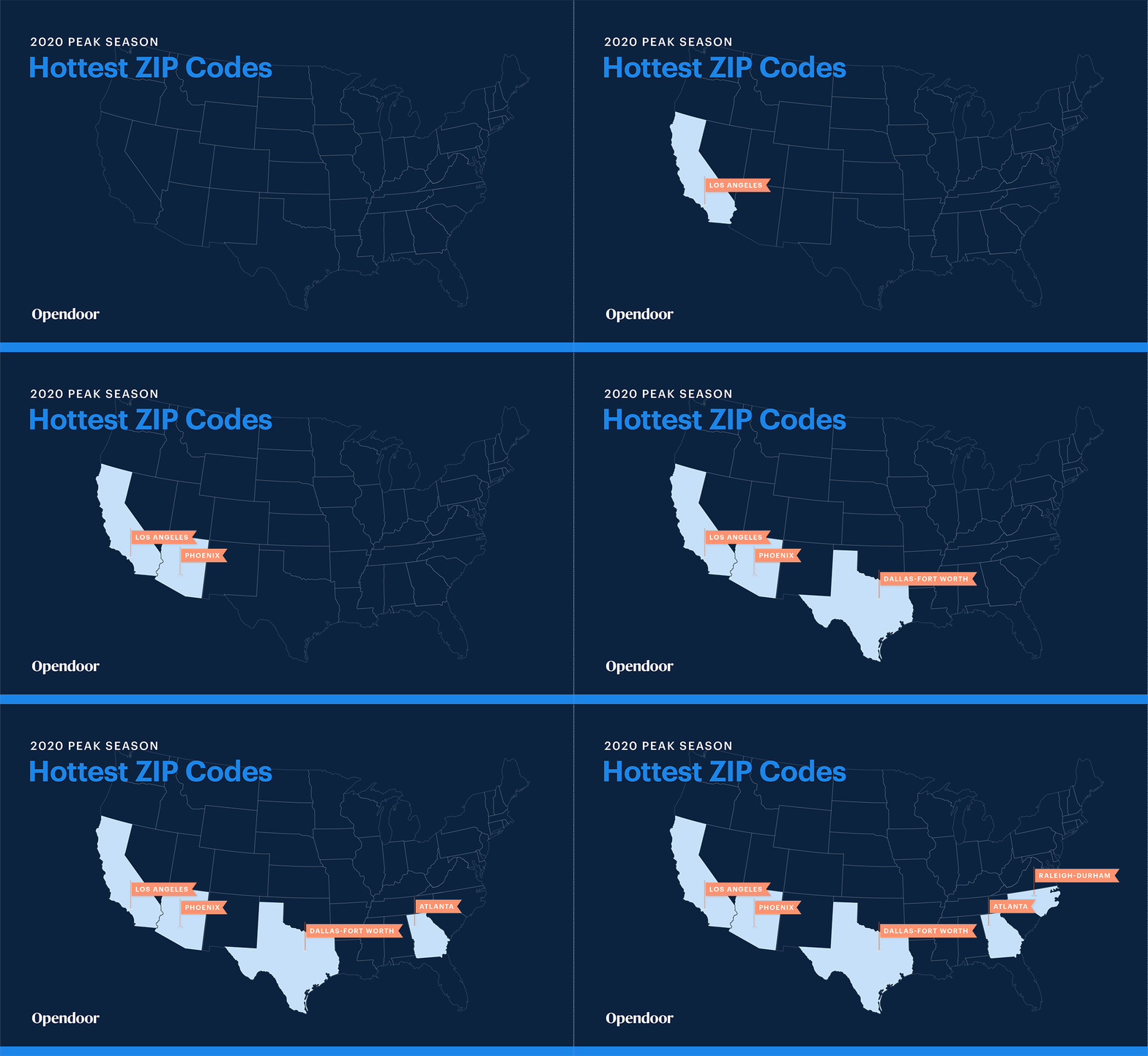
In 2026, Americans are still on the move — and the patterns are clearer than ever. Sunbelt states continue to dominate as top destinations, affordable mid-size cities are pulling residents away from expensive coastal metros, and remote work flexibility keeps reshaping where people choose to live. According to the United Van Lines 2025 National Movers Study, the South and Southeast accounted for seven of the top ten inbound states for the third consecutive year.
At Opendoor, we see these migration trends play out in real time. Every day, homeowners sell to us in one market and buy in another — giving us a front-row seat to where people are moving, why they're leaving, and what they're chasing. This article breaks down the latest migration data, highlights the most popular cities and states people are moving to, reveals which places they're leaving behind, and explains the driving forces behind the biggest relocation wave in a generation.
Whether you're thinking about selling your home or simply curious about where the country is headed, here's what the data tells us.
Get an offer with a click of a button!
Sell your home directly to Opendoor, so you can skip all the hassle and months of uncertainty. Simply enter your address – and get our offer with a few simple steps.
Moving Trends in 2026: What's Changed
Migration patterns in 2026 aren't brand new — but several key trends have accelerated, evolved, or reversed in ways that matter for anyone considering a move. Here are the five macro forces shaping where people are relocating this year.
Remote Work Continues to Reshape Migration
The remote work revolution didn't fade after the pandemic — it matured. According to Stanford University's Survey of Working Arrangements and Attitudes, roughly 28% of full workdays in early 2026 are performed from home, holding steady from 2025 levels. This means tens of millions of workers still have the freedom to live wherever they want, regardless of where their employer is headquartered.
The result: mid-size cities with lower costs of living and higher quality of life keep attracting remote workers who previously would have been anchored to San Francisco, New York, or Chicago. Cities like Boise, Raleigh, and Greenville have seen sustained population growth driven in large part by this shift.
Housing Affordability Is the #1 Driver
When asked why they moved, cost of living and housing affordability top every major survey. The National Association of Realtors' 2025 Profile of Home Buyers and Sellers found that 45% of interstate movers cited affordability as their primary reason for relocating — up from 38% in 2022. With the national median home price hovering near $420,000 according to Zillow's latest housing data, buyers are looking for markets where their dollar stretches further. If you're wondering how much it costs to buy a house in a new market, the price gap between coastal metros and Sunbelt cities remains significant — often $150,000 or more for comparable homes.
The Sunbelt Boom Is Evolving
For the past decade, the Sunbelt migration story has been straightforward: people flood into Texas, Florida, Arizona, and the Carolinas. That hasn't stopped, but it's becoming more nuanced. Some Sunbelt boomtowns — particularly Austin and parts of South Florida — have seen their own affordability crises emerge as demand outpaced supply. According to Redfin's 2025 migration report, net inflows to Austin slowed by 12% year-over-year, while secondary Sunbelt cities like Huntsville, Alabama and Lakeland, Florida saw accelerating growth. The Sunbelt isn't cooling off — it's spreading out.
Climate and Quality of Life Are Gaining Influence
Climate considerations are no longer a fringe factor. A Redfin survey from late 2025 found that nearly 1 in 5 recent movers said natural disaster risk or climate concerns influenced their decision. Wildfire risk in California, hurricane exposure in coastal Florida, and extreme heat in Phoenix are prompting some residents to reconsider. Meanwhile, states with perceived quality-of-life advantages — temperate climates, outdoor recreation, strong schools — are drawing families. Tennessee, Colorado, and the Carolinas consistently rank high on quality-of-life migration.
Tax-Friendly States Keep Winning
States with no income tax continue to punch above their weight in attracting new residents. According to the Tax Foundation's 2026 State Tax Competitiveness Index, the nine states with no income tax — including Texas, Florida, Tennessee, and Nevada — collectively gained over 800,000 net domestic migrants between 2023 and 2025. For high earners and retirees especially, the tax savings of moving from California (top marginal rate: 13.3%) or New York (top rate: 10.9%) to a zero-income-tax state can amount to tens of thousands of dollars annually.
Top 10 Cities People Are Moving To in 2026
Based on a combination of U.S. Census Bureau domestic migration estimates, U-Haul's 2025 Growth Cities report, and Redfin net inflow data, these are the most popular cities to move to right now:
| Rank | City | State | Est. Net Migration (2025) | Median Home Price | YoY Price Change |
|---|---|---|---|---|---|
| 1 | Houston | TX | +48,200 | $315,000 | +3.1% |
| 2 | Dallas–Fort Worth | TX | +45,800 | $380,000 | +2.8% |
| 3 | Phoenix | AZ | +38,500 | $420,000 | +1.9% |
| 4 | Charlotte | NC | +32,100 | $375,000 | +4.2% |
| 5 | San Antonio | TX | +28,600 | $285,000 | +3.5% |
| 6 | Jacksonville | FL | +26,400 | $355,000 | +2.4% |
| 7 | Raleigh | NC | +24,800 | $405,000 | +3.8% |
| 8 | Nashville | TN | +23,100 | $430,000 | +2.1% |
| 9 | Tampa | FL | +22,700 | $365,000 | +1.7% |
| 10 | Boise | ID | +18,300 | $440,000 | +2.5% |
A few things stand out. Texas alone claims three of the top five spots, driven by a combination of job growth, no state income tax, and a relatively large inventory of new-construction homes. North Carolina is the breakout story of the past two years — Charlotte and Raleigh both offer strong job markets (banking, tech, healthcare) at price points well below the Northeast corridor.
If you're considering making a move to one of these metros, understanding what your current home is worth is a critical first step. The equity you've built could go significantly further in a lower-cost market.
Top States People Are Moving To
At the state level, the migration picture reinforces the city-level data — but adds a few surprises. Based on the United Van Lines 2025 study and Census Bureau population estimates, here are the top inbound states:
Texas — Leading the nation in net domestic migration for the fourth consecutive year, with an estimated +175,000 net new residents in 2025.
Florida — Despite rising insurance costs and hurricane concerns, Florida added roughly +130,000 net domestic migrants, buoyed by retirees and remote workers.
North Carolina — The fastest-growing East Coast state, with +95,000 net movers drawn by the Research Triangle, Charlotte's financial sector, and mountain-town appeal.
South Carolina — Charleston, Greenville, and Myrtle Beach are all growing rapidly. Net migration: +62,000.
Tennessee — Nashville's cultural cachet, no income tax, and central location keep Tennessee in the top five. Net migration: +55,000.
Georgia — Metro Atlanta remains a magnet, especially for Black professionals and families relocating from the Northeast. Net migration: +48,000.
Arizona — Phoenix and Tucson continue to draw Californians, though the pace has moderated. Net migration: +45,000.
Idaho — Boise's tech scene and outdoor lifestyle attract Pacific Northwest transplants. Net migration: +28,000.
Nevada — Las Vegas's diversifying economy and zero income tax draw both retirees and young professionals. Net migration: +25,000.
Alabama — An emerging story. Huntsville's aerospace and defense sector has made it one of the fastest-growing small metros in the country. Net migration: +18,000.
Why Texas, Florida, and North Carolina Keep Dominating
These three states share a common formula: job growth + tax advantages + relative affordability + warm climate. Texas and Florida benefit from having no state income tax, which is an immediate financial incentive for anyone earning above the median. North Carolina's income tax rate (currently 4.5% and declining under state legislation) is among the lowest for states that do levy one.
All three also have diversified economies. Texas has energy, tech, healthcare, and logistics. Florida has tourism, finance, and a booming healthcare sector. North Carolina has banking (Charlotte is the second-largest banking center in the U.S.), biotech, and higher education.
Emerging States to Watch in 2026
Beyond the usual suspects, several states are quietly building momentum:
- Alabama — Huntsville is the story here. NASA's Marshall Space Flight Center, the FBI's new operational hub, and a wave of defense contractors have created a high-paying job market with a median home price under $300,000.
- Arkansas — Northwest Arkansas (Bentonville, Fayetteville) is attracting remote workers with its low cost of living, world-class mountain biking, and the cultural investment of the Walton family's Crystal Bridges Museum.
- Maine — A countertrend. Some remote workers are choosing quality of life over warm weather, and Maine's coastal towns are seeing modest but consistent inbound migration from Boston and New York metro residents.
Cities and States People Are Leaving
Migration is a two-sided story. For every booming Sunbelt city gaining residents, there's a metro or state watching people leave. Understanding where people are moving from is just as important as knowing where they're going.
Top Cities Losing Residents
According to Census Bureau metro-level migration data and Redfin's outbound migration tracker, these metros experienced the highest net domestic outflows in 2025:
Los Angeles, CA — Net outflow: −92,000
New York City, NY — Net outflow: −78,000
San Francisco, CA — Net outflow: −55,000
Chicago, IL — Net outflow: −48,000
San Jose, CA — Net outflow: −32,000
Washington, D.C. — Net outflow: −24,000
Seattle, WA — Net outflow: −18,000
Boston, MA — Net outflow: −15,000
California dominates this list, claiming three of the top five outbound metros. But it's worth noting that international immigration partially offsets these domestic losses — New York and Los Angeles still grow in total population thanks to foreign-born arrivals.
Why People Are Leaving California, New York, and Illinois
The reasons are consistent and well-documented:
- Housing costs. The median home price in San Francisco exceeds $1.2 million according to Zillow. In Manhattan, the median is above $1 million. Even Chicago, historically one of the more affordable major cities, has seen prices climb to levels that push middle-income families to the suburbs or out of state entirely.
- State and local taxes. California's top income tax rate of 13.3% and New York's combined state and city taxes create a significant burden — especially for high earners who can now work remotely from anywhere. Illinois's flat 4.95% income tax, combined with some of the highest property taxes in the nation, compounds the pressure.
- Quality-of-life concerns. Survey respondents frequently cite crime, homelessness, congestion, and political dissatisfaction as secondary motivators for leaving, though affordability remains the dominant factor.
If you're in a high-outflow market and considering selling before prices cool further, it's smart to understand how to sell your house fast and explore options like getting a cash offer to simplify the process.
Why Are People Relocating in 2026?
Beyond the geographic data, it's worth digging into the motivations behind this sustained migration wave. Why are so many people relocating — and why now?
Cost of Living and Affordability
This is the dominant driver, full stop. When your mortgage payment in Dallas buys a home twice the size of what it would in Brooklyn — and you get to keep an extra 10%+ of your income by avoiding state taxes — the math does the persuading. The Joint Center for Housing Studies at Harvard found that housing cost burden (spending more than 30% of income on housing) affects 40% of renters and 20% of homeowners nationwide. Moving to a lower-cost market is the most direct way to escape that burden.
Knowing the cost of selling your current home helps you plan realistically for what you'll net from the sale — and what you can afford in your new city.
Remote and Hybrid Work Flexibility
We covered this in the trends section, but it's worth emphasizing as a personal motivator: the ability to keep a high-paying job while living somewhere cheaper has unlocked moves that would have been impossible a decade ago. A software engineer earning $180,000 in San Francisco can now earn $160,000 remotely while living in Nashville — and come out far ahead financially after accounting for housing and taxes.
Better Quality of Life
For families especially, the move often comes down to more space, better schools, less traffic, and access to outdoor recreation. Cities like Charlotte, Raleigh, Boise, and Nashville consistently rank high in quality-of-life surveys because they offer a balance: they're big enough to have cultural amenities, restaurants, and strong job markets, but small enough to avoid the gridlock and stress of a mega-city.
Retirement and Family Proximity
Retirees continue to migrate toward warm-weather, tax-friendly states — Florida, Arizona, and the Carolinas are perennial favorites. But a growing subset of movers are relocating to be closer to family, particularly as aging parents need support or as young families want grandparents nearby. According to the National Association of Realtors, 22% of recent movers over 55 cited family proximity as a top-three reason for relocating. For those looking to accommodate multiple generations under one roof, finding a multi-generational family home is increasingly common.
What Opendoor's Market Data Reveals
At Opendoor, we operate in dozens of major markets across the country — and our transaction data tells a story that mirrors the national trends, with a few nuances you won't find in Census data.
People are selling in high-cost markets and buying in high-growth ones. We've seen a consistent pattern of homeowners requesting offers in markets like Phoenix, Los Angeles, and the Bay Area, then purchasing in Texas metros (Houston, Dallas–Fort Worth, San Antonio) and the Carolinas. The typical seller in this pattern is a homeowner in their 30s or 40s with significant equity who wants to "upgrade" their lifestyle — more square footage, a newer home, and a lower monthly payment.
Speed matters more than ever. Relocating homeowners often tell us they need to sell quickly to align with a job start date, a lease ending, or a school enrollment deadline. Traditional listings that sit on the market for weeks don't always fit that timeline. That's why understanding how long it takes to close and what factors affect your timeline — from appraisals to closing costs — can make or break a smooth relocation.
Sellers are choosing certainty. In a market where days on market vary widely by metro and price fluctuations create anxiety, we've seen more homeowners gravitating toward cash offers and streamlined sales processes. The appeal isn't just speed — it's the ability to plan your move with a firm close date and no financing contingencies to worry about.
These aren't abstract data points. They're patterns we see in the thousands of transactions we facilitate every quarter, and they underscore a simple truth: Americans are voting with their feet, and the places that offer affordability, opportunity, and quality of life are winning.
How Opendoor Makes Your Move Easier
Relocating to a new city is exciting — but selling your current home can be the most stressful part of the process. Between prepping the house, scheduling showings, waiting for offers, and navigating the closing process, a traditional sale can take months.
Opendoor offers a simpler path. You can request a competitive cash offer on your home, choose your closing date, and skip the hassle of repairs, staging, and open houses. Whether you're moving across the state or across the country, Opendoor lets you sell on your timeline so you can focus on what matters — settling into your new home and community.
Ready to see what your home is worth? Get your free offer from Opendoor and take the first step toward your next chapter. You can also explore how selling to Opendoor compares to a traditional sale to decide which option fits your situation.
Get an offer with a click of a button!
Sell your home directly to Opendoor, so you can skip all the hassle and months of uncertainty. Simply enter your address – and get our offer with a few simple steps.
Want a faster path to selling? Compare your options in Asheville, El Paso, and South Texas with an instant Opendoor offer. Available across Indiana.