Selling a home means writing checks you didn't know existed - or more accurately, watching thousands disappear from your proceeds before you ever see them. Between agent commissions, government fees, and a dozen smaller charges, most sellers hand over 8% to 10% of their sale price just to complete the transaction.
This guide breaks down every fee you'll encounter, shows you how to calculate your actual take-home amount, and reveals where you can negotiate to keep more money in your pocket.
What are seller closing costs?
Seller closing costs are the fees you pay when transferring ownership of your home to a buyer. The total typically runs between 8% and 10% of your sale price, which means on a $362,000 home, you're looking at roughly $29,000 to $36,000.
Here's the part that surprises most first-time sellers: you won't write a check for any of this. Everything gets deducted from your sale proceeds at closing, so the money never hits your bank account in the first place. The escrow company handles all the math, subtracts what you owe, and wires you what's left.
Typical closing costs for sellers and their price tags
Every sale involves a handful of standard fees. Some are negotiable, others are set by your state or county. Let's walk through each one.
Real estate agent commission
Agent commissions take the biggest bite out of your proceeds. The total commission has historically ranged from 5% to 6% of your sale price, though recent industry changes mean you have more room to negotiate.
On a $400,000 home with a 5% total commission, you'd pay $20,000 at closing. That commission typically gets split between your listing agent and the buyer's agent. After August 2024, new rules shifted how commissions work - buyers now sign agreements with their agents and can negotiate what they pay separately from what you offer, though commissions reached 2.40% by early 2025.
Transfer or deed tax
Transfer taxes are government fees charged when ownership changes hands. Your state, county, or city collects this money to record the sale in public records.
The cost swings wildly depending on where you live. Texas charges nothing. Washington State might charge over $11,000 on a median-priced home. California, New York, and Delaware all have substantial transfer taxes that can exceed 2% of your sale price when you combine state and local fees.
Owner's title insurance
Title insurance protects your buyer if someone later claims they own your property or if old contractor bills surface after closing. In most markets, sellers pay for the buyer's owner's title insurance policy.
The premium typically runs around 0.5% of your sale price. On a $400,000 home, expect to pay roughly $2,000 for this one-time policy. You might see two title insurance charges on your closing documents - one for the owner's policy and one for the lender's policy. The buyer usually pays the lender's policy.
Get an offer with a click of a button
Sell your home directly to Opendoor, so you can skip all the hassle and months of uncertainty. Simply enter your address – and get our offer with a few simple steps.
Escrow or settlement fee
The escrow company acts as the neutral middleman who holds the buyer's money and manages all the closing paperwork. Settlement fees cover document preparation, notarization, recording the deed, and wiring funds.
Costs range from $200 to 0.5% of the purchase price depending on your state. Some states split this fee between buyer and seller. Others put the full amount on the seller.
Prorated property taxes
You pay property taxes through your closing date, then the buyer takes over. If you've already paid taxes for the full year, you'll get a credit back for the unused portion. If you haven't paid yet, you owe your share at closing.
Here's an example: you close on July 15 and your annual property tax is $6,000. You'd owe roughly $3,250 for the seven and a half months you owned the home that year.
HOA fees and payoffs
Homeowners associations charge transfer fees when ownership changes, typically between $100 and $500. You'll also pay any outstanding monthly or quarterly dues through your closing date.
Some HOAs require sellers to provide documents for buyers - things like financial statements or rules and regulations. Preparing those packages can cost another $200 to $400 in administrative fees.
Seller concessions to buyer
In slower markets, you might agree to pay some of the buyer's closing costs to sweeten the deal. These seller concessions can range from 1% to 3% of the purchase price.
The credit reduces your net proceeds but can help close the sale faster or at a higher price. Lenders cap how much you can offer based on the buyer's loan type and down payment size.
Loan payoff and prepayment penalty
Your outstanding mortgage balance gets paid off at closing from your sale proceeds. Some lenders charge prepayment penalties if you pay off your loan early - usually 1% to 2% of what you still owe.
Check your original mortgage paperwork or call your lender to see if this applies to you. If you have a home equity loan or HELOC, those balances also get paid in full before ownership transfers.
Miscellaneous recording and courier fees
Small administrative costs add up quickly:
- Recording fees: $50 to $250 to file your deed with the county
- Notary services: $50 to $150 for document signing
- Courier fees: $25 to $75 for delivering paperwork
- Final utility readings: $50 to $200 for water, gas, or electric
Each one seems minor, but together they can add several hundred dollars to your closing costs.
Get an offer with a click of a button
Sell your home directly to Opendoor, so you can skip all the hassle and months of uncertainty. Simply enter your address – and get our offer with a few simple steps.
Related: who pays real estate agent commission fees.
How much are seller closing costs on average?
Percentage of sale price range
Most sellers pay between 8% and 10% of their home's sale price in total closing costs. That range shifts based on where you live and what you negotiate with agents.
High-tax states like New York or California push you toward the upper end. States with no transfer taxes and lower commissions bring you closer to 6% or 7%.
Dollar examples for different home values
Here's what closing costs look like across different price points:
| Home Price | 8% Closing Costs | 10% Closing Costs |
|---|---|---|
| $250,000 | $20,000 | $25,000 |
| $400,000 | $32,000 | $40,000 |
| $600,000 | $48,000 | $60,000 |
Keep in mind these figures assume typical agent commissions of 5% to 6%. If you negotiate lower rates or use a different selling method, your total drops.
Related: how much does it cost to sell a house.
Seller closing cost example: $400,000 home
It's easier to see what 6%–10% actually feels like with one realistic example. Imagine a $400,000 home sale with a 5.5% combined agent commission, an owner's title insurance policy of about 0.5%, an escrow/settlement fee of $1,200, $1,000 in recording and miscellaneous fees, $2,000 in transfer or stamp taxes (varies by state — see the breakdown below), 30 days of prorated property taxes at $4,800/year, and a $5,000 buyer concession at the end of negotiation.
| Line item | Estimated cost |
|---|---|
| Agent commissions (5.5% combined) | $22,000 |
| Owner's title insurance (0.5%) | $2,000 |
| Escrow / settlement fee | $1,200 |
| Recording, courier, misc. fees | $1,000 |
| Transfer / stamp tax (varies by state) | $2,000 |
| Prorated property taxes (~30 days) | $400 |
| Buyer concession | $5,000 |
| Total seller closing costs | ~$33,600 |
| Closing costs as % of sale price | ~8.4% |
A few patterns this illustrates:
- Agent commissions are the biggest single line. Removing them — for example, by accepting an Opendoor cash offer — moves the percentage sharply lower, though the service charge replaces some of that savings.
- State-specific items can shift the total by 1–2 percentage points. Florida's documentary stamp tax adds roughly $0.70 per $100 of sale price; California's documentary transfer tax adds about $1.10 per $1,000 at the county level (cities can add more); Texas and Missouri have no state transfer tax at all.
- Concessions are negotiable but increasingly common. Industry data on seller concessions shows they typically run 3%–6% of sale price when offered.
You won't get a final, signed number for closing costs until the closing disclosure lands in your inbox at least three business days before closing — that's the federally required summary of every fee on both sides of the transaction.
Closing cost calculator for sellers quick formula
You can estimate your costs in three steps.
Step 1 add mandatory fees
Start with the costs you can't negotiate. Look up your local transfer tax rate on your county assessor's website, then add any recording fees your state requires. Don't forget your outstanding mortgage balance.
If you're selling a $400,000 home in a county with a 1.5% transfer tax and you owe $200,000 on your mortgage, your mandatory costs are $6,000 in transfer taxes plus your $200,000 loan payoff.
Step 2 estimate negotiable costs
Next, add your agent commission and other variable expenses. If you've agreed to a 5% total commission, that's $20,000 on a $400,000 sale. Tack on title insurance at around 0.5%, settlement fees between $500 and $2,000, and any seller concessions you've offered.
You can shop around for title and escrow services to find better rates. Calling three to five providers might save you $500 to $1,000.
Step 3 subtract mortgage payoff to find net
Take your sale price and subtract everything from steps one and two. What's left is your net proceeds - the actual amount you'll receive after closing.
On a $400,000 sale with $28,000 in total closing costs and a $200,000 mortgage, you'd net $172,000. Remember this is an estimate. Your final closing disclosure arrives three days before closing with exact numbers.
When are closing costs for sellers paid?
At the settlement table
All seller closing costs get paid on closing day when ownership transfers. You won't write individual checks - the escrow company deducts everything from your sale proceeds automatically.
Through escrow withheld from proceeds
The title company or settlement attorney collects the buyer's funds, subtracts your closing costs and mortgage payoff, and then sends you what remains. You typically receive your net proceeds within 24 to 48 hours after signing.
How to reduce closing fees when you sell
Negotiate commission or go flat fee
Commissions are negotiable, always. You might offer a buyer's agent 2% to 2.5% instead of 3%, or hire a flat-fee listing service that charges a few hundred dollars instead of a percentage.
If you're buying and selling with the same agent, ask about a discount for the double transaction. Agents in hot markets where homes sell quickly may also accept lower rates.
Shop title and escrow services
Title and escrow companies set their own prices. Call around and compare quotes - you might find $500 to $1,000 differences for identical services.
Ask about reissue rates if you've owned your home for less than 10 years. This discount can cut your title insurance premium by 20% to 40%.
Time the closing date for tax savings
Closing early in the month means you owe less in prorated property taxes and HOA fees. Close on the 5th instead of the 25th and you save roughly two-thirds of that month's expenses.
Work with your buyer to pick a date that minimizes your obligations while meeting everyone's timeline.
Offer credits instead of price cuts
When a buyer asks for a $10,000 price reduction, consider offering a $10,000 closing cost credit instead. Your sale price stays higher, which matters for neighborhood comparables and appraisals.
Credits also help buyers who are short on cash but can qualify for a slightly higher loan amount.
Sell to a cash buyer like Opendoor
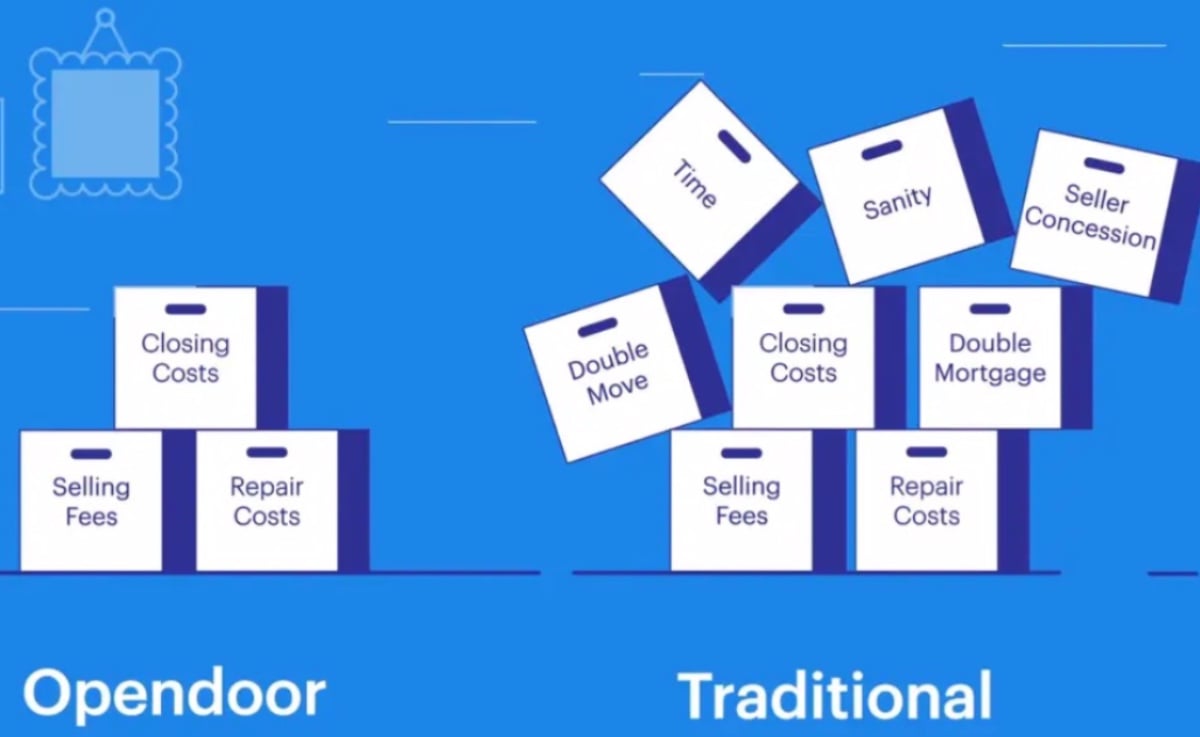
Cash buyers eliminate many traditional closing costs. When you sell to Opendoor, you skip buyer-side agent commissions, avoid buyer-requested repairs, and receive a transparent cost breakdown upfront.
You also get certainty - no financing contingencies and a closing date you control. Get a free, no-obligation cash offer to see your estimated net proceeds.
Related: seller concessions explained · hidden costs of selling a house: 10 fees sellers often miss.
State and local variations in closing costs
High-cost states to watch
New York, Washington, California, and Delaware all charge substantial transfer taxes. Combined state and local fees can exceed 2% of your sale price in these markets.
Cities add their own layers too. San Francisco, Seattle, and Philadelphia tack on municipal transfer taxes beyond what the state charges. If you're selling in one of these areas, budget an extra 1% to 3% for government fees alone.
Low-cost states and transfer-tax exemptions
Texas, Missouri, and several other states charge no state-level transfer taxes. Your closing costs in these markets lean more heavily toward commissions and title fees rather than government charges.
Some states offer exemptions for seniors or properties under certain price thresholds. Check with your local assessor's office to see if you qualify.
Closing costs for sellers, state by state: what's different
The 6%–10% national range holds in most states, but the mix of fees is genuinely different. Three big drivers create the variation: (1) who customarily pays for the owner's title insurance policy, (2) whether the state, county, or city imposes a transfer or stamp tax, and (3) whether the closing is run by an escrow company, a title company, or an attorney.
| State | Seller-customary items beyond commissions + escrow | Transfer/stamp tax (seller side) |
|---|---|---|
| Florida | Owner's title insurance (most counties); HOA estoppel fees | Documentary stamp tax: $0.70 per $100 of sale price (Miami-Dade differs) |
| Texas | Owner's title insurance (customarily seller); HOA transfer fees if applicable | None at state level |
| California | County-recorded deed; HOA transfer fees | Documentary transfer tax ~ $1.10 per $1,000 at county level (cities add more) |
| New Jersey | Attorney fee (most closings); title work | Realty Transfer Fee (tiered by sale price); mansion tax above $1M is buyer-side |
| New York | Attorney fee (standard); transfer taxes | NY State transfer tax + NYC RPT (if applicable) |
| Illinois | Attorney fee (standard in Chicago area); title work | State + county transfer stamps; municipal stamps in some cities |
| Missouri | Owner's title insurance (negotiable) | None at state level |
| Louisiana | Notary-driven closing; title fees | None at state level for most residential sales |
A few takeaways:
- Attorney states (NJ, NY, MA, IL Chicago-area, plus most of the Northeast) layer in a $500–$2,000 attorney fee that escrow states don't have.
- No-state-transfer-tax states like Texas and Missouri keep the per-transaction load on the low end of the 6%–10% range, all else equal.
- Florida is unusual: the seller customarily pays for the owner's title insurance in most counties, which adds roughly 0.5%–0.6% to seller-side closing costs compared with states where the buyer covers it.
For the exact dollar figures in your sale, your closing disclosure is the source of truth. If you'd rather preview the net before listing, request a free Opendoor offer — the offer breakdown shows estimated standard closing costs for your specific market alongside the service charge.
See your net proceeds the stress-free way
Knowing your closing costs upfront removes the guesswork from selling. When you understand exactly what you'll pay, you can plan your next move with confidence instead of waiting until three days before closing to see the final numbers.
Traditional sales often come with surprise fees or last-minute adjustments. With Opendoor, you receive a transparent breakdown of all costs from day one. You choose your closing date, skip the showings, and move forward on your schedule. Start with a free, no-obligation cash offer and see what you'll actually receive in minutes.
Related: see your net proceeds with an Opendoor offer.
Looking to sell a home in California? Opendoor makes selling simple in Las Vegas, Seattle, and St Louis — request a free, no-obligation cash offer.