
School Quality and Home Prices: The 2025 Market Analysis
When families shop for homes, they're rarely buying just a house-they're buying access to a neighborhood, a community, and most importantly, a school district. In markets across the country, homes near highly rated schools command premiums of 10% to 50% or more, even for buyers who don't have children yet.
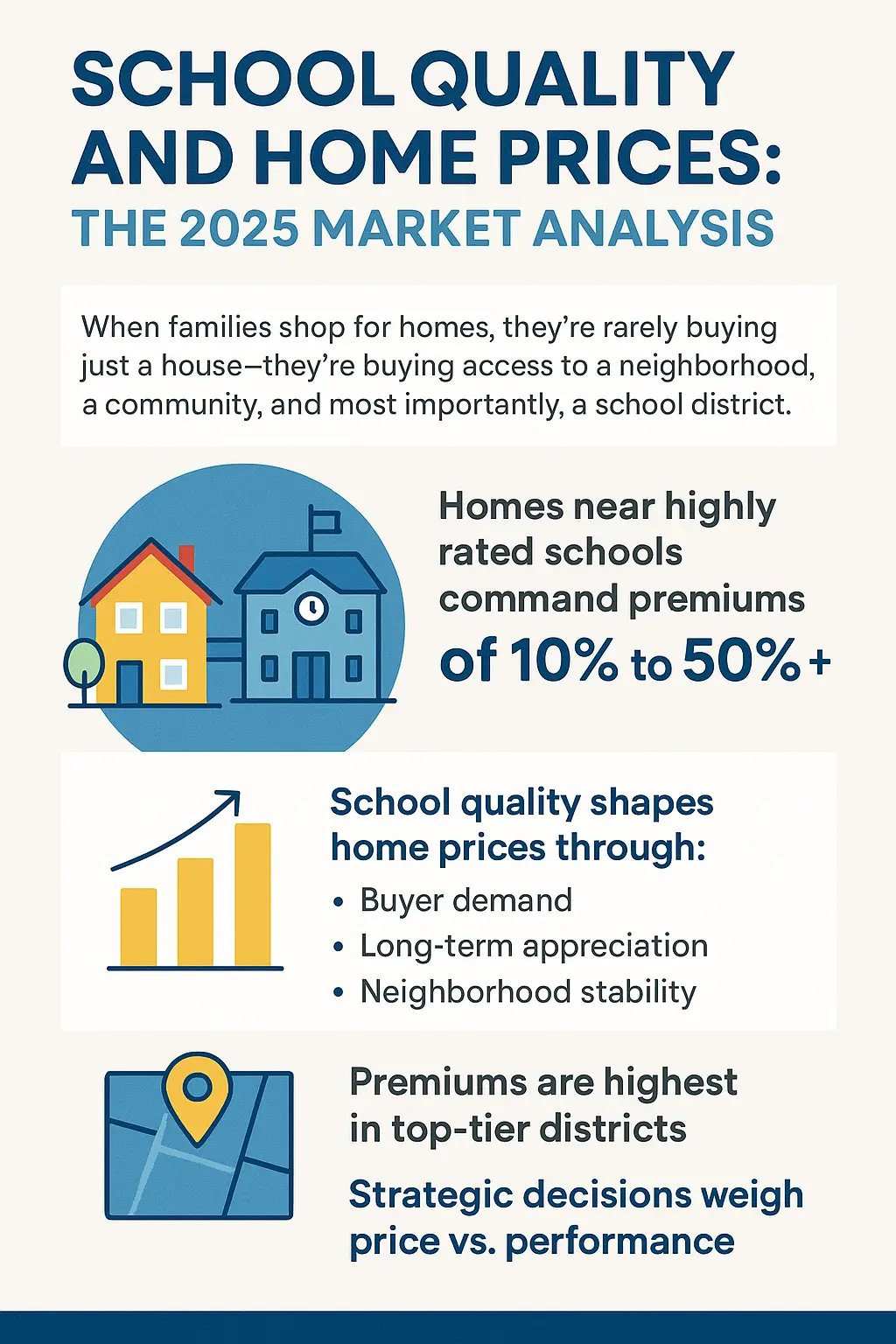
School quality shapes home prices through a combination of buyer demand, long-term appreciation, and neighborhood stability-making it one of several key factors that influence home value. This guide breaks down how school ratings influence property values, where premiums are highest, and how to make strategic decisions whether you're buying in a top-tier district or weighing trade-offs between price and performance.
Why do school ratings move home prices
Homes in highly rated school districts typically cost 10% to 20% more than similar properties in average-performing areas. In some markets, that premium jumps to 49% or higher. The reason is straightforward: families compete for access to quality education, and that competition drives up prices.
Here's what the data shows. Research from the National Bureau of Economic Research found that every dollar a community spends on public schools increases home values by $20. Meanwhile, properties near schools rated 8 or higher on platforms like GreatSchools sell faster and command higher prices than homes in districts rated below 5.
Three factors explain why school ratings create such a powerful effect on pricing. First, families with children actively seek out top-performing districts and compete for limited inventory. Second, strong schools signal broader community investment-better infrastructure, engaged neighbors, and stable property values. Third, buyers without children recognize that a home in a desirable school district will be easier to sell later.
Perceived quality and demand
When buyers search for homes, school ratings often serve as shorthand for neighborhood quality. A district with high test scores and strong graduation rates signals that families prioritize education and community involvement. This perception creates intense competition for homes within district boundaries, even among buyers who don't have school-age children yet.
The demand effect is immediate. Homes in top-rated school districts receive more online views, attract more showings, and sell an average of eight days faster than comparable properties in lower-rated areas. Buyers frequently stretch their budgets or compromise on home size to secure an address within a preferred district.
Test scores and tax revenue signals
Standardized test scores provide an accessible measure of school performance, making them a primary data point for buyers comparing neighborhoods. While test scores don't capture everything about a school's quality-like teaching methods or support services-they offer a consistent benchmark across districts.
Property taxes play a dual role here. Homes in high-performing districts often carry higher tax bills because property taxes fund the schools that make the district attractive in the first place. Buyers accept the higher ongoing cost because they're investing in both their home and access to quality education.
Community stability and safety
Strong schools often anchor stable, well-maintained neighborhoods. Families who move into top-rated districts tend to stay longer, which reduces turnover and fosters continuity. Active parent-teacher organizations and community involvement create social networks that extend beyond the classroom.
Lower crime rates, cleaner streets, and better-maintained homes become self-reinforcing. Homeowners invest in their properties because they plan to stay, and new buyers pay a premium to join an established community. Even during economic downturns, homes in highly rated school districts tend to hold their value better than properties in lower-performing areas.
Find your perfect home
Opendoor owns hundreds of homes for sale near you. See homes on the market, or get a sneak peek at those that have yet to hit the market.
2025 premiums by school rating band
The premium you'll pay varies widely depending on the rating tier. In 2025, the median list price in the nation's highest-rated school districts reached $1.21 million-a 125% premium over the surrounding metro area average. That's not uniform across all markets or all rating levels, though.
Homes in districts with average school ratings of 9 or 10 command the highest markups. Properties in districts rated 5 to 7 offer a middle ground between affordability and quality. Below a rating of 5, prices often reflect a discount rather than a premium, and homes may take longer to sell.
Rating 9–10 districts
Top-tier school districts represent the luxury segment of the education-driven housing market. Homes in Carroll Independent School District in the Dallas suburb of Southlake, for example, command a 391% premium. The median list price there is $2.16 million compared to $439,967 outside the district.
Buyers in this tier often include affluent families avoiding private school tuition, which averages over $10,000 annually per child. You'll also find investors and young professionals who recognize that top-rated addresses offer the strongest appreciation potential. Competition is fierce, and homes often receive multiple offers within days of listing.
Rating 7–8 districts
Mid-tier districts offer a compelling balance for buyers who want strong schools without extreme premiums. Homes in districts rated 7 or 8 typically sell for 20% to 50% more than the metro average, making them accessible to a broader range of buyers.
You still benefit from many advantages of a strong school district-engaged communities, well-maintained properties, and solid appreciation-without the intense bidding wars common in 9- or 10-rated areas. If you're weighing trade-offs between home size and school quality, this tier often delivers the best overall value.
Rating 5–6 districts
Moderate school districts represent an opportunity for buyers who can tolerate some trade-offs in exchange for lower prices. Homes in rating 5–6 areas typically sell at or slightly above the metro median, depending on other neighborhood factors like commute times and safety.
Buyers in this tier often include first-time homeowners, investors seeking rental properties, or families planning to use private schools. If the district shows signs of improvement-new school construction or rising test scores-you may capture appreciation as the rating climbs and more buyers take notice.
Rating below 5
Districts rated below 5 typically reflect systemic challenges: underfunding, lower test scores, and less community investment. Homes in lower-rated areas often sell at a discount to the metro median, and they may sit on the market longer.
The key risk is resale. Even if you don't have children or don't prioritize school quality, future buyers will. A low-rated district can limit your pool of interested buyers when it's time to sell. On the other hand, if the district begins to improve or the neighborhood undergoes revitalization, early buyers can benefit from significant appreciation.
Regions with the highest and lowest school premiums
Geography plays a major role in determining how much school quality affects home prices. Coastal markets, particularly in California and the Northeast, show the most extreme premiums. Midwest and Sun Belt markets offer more moderate spreads.
In general, markets with limited housing supply, high median incomes, and strong job growth see the steepest school-related premiums. Regions with ample new construction and lower cost of living show smaller gaps between top-rated and average-rated districts.
West Coast hotspots
California dominates the list of highest school premiums in the country. Laguna Beach Unified School District commands a 322% premium, with median home prices around $5 million compared to $1.19 million in the broader Los Angeles metro. Reed Union Elementary School District in the San Francisco Bay Area shows a similar pattern, with homes priced at $4 million-304% higher than the metro median.
California's combination of limited housing supply, high incomes, and intense competition for quality schools drives premium pricing. Buyers often face bidding wars, waived contingencies, and all-cash offers just to secure a home within district boundaries.
Sun Belt growth corridors
Texas, Florida, and Arizona offer a more moderate version of the school premium dynamic. In Dallas, homes in top-rated Carroll Independent School District carry a 391% premium, but the surrounding metro area remains relatively affordable, with a median of $439,900.
Sun Belt markets benefit from ongoing population growth, new construction, and expanding school systems. If you're willing to buy in a developing area before a new school opens or ratings improve, you may capture appreciation as the neighborhood matures.
Midwest affordability zones
Midwestern markets like St. Louis show significant school premiums within their metros, but overall home prices remain far below coastal levels. Ladue School District in St. Louis carries a 222% premium with a median price of $968,247-high for the region, but still accessible compared to California or the Northeast.
The Midwest offers an opportunity to secure a home in a strong school district without the financial strain common in higher-cost markets. However, appreciation tends to be slower, and resale timelines may be longer.
Northeast legacy districts
The Northeast features some of the oldest and most established school systems in the country. New Hope-Solebury School District outside Philadelphia commands a 224% premium, with homes listing at $1.24 million compared to $383,000 in the surrounding metro.
Buyers in the Northeast often prioritize historical reputation and proximity to major cities. However, aging infrastructure, higher property taxes, and limited new construction can create affordability challenges even in districts that aren't top-rated.
How fast homes appreciate in top districts
One of the most compelling reasons to buy in a strong school district is the long-term appreciation potential. Homes in highly rated districts tend to outpace the market during growth periods and hold their value better during downturns.
Appreciation rates vary by market, but the pattern is consistent: top-rated districts see stronger, steadier gains over time. If you're comparing two similar homes in different districts, the one in the stronger district will likely be worth more in five or ten years, even if the starting price is higher.
Five-year appreciation trends
Over a five-year period, homes in districts rated 8 or higher typically appreciate 15% to 25% faster than properties in average-performing districts. This difference compounds over time. A home that starts at $500,000 in a top district might be worth $625,000 after five years, while a comparable home in an average district might only reach $575,000.
The appreciation advantage comes from sustained demand. Families continue to compete for limited inventory in desirable districts, which keeps prices rising even when the broader market softens.
Downturn resilience metrics
During the last recession, homes in school districts rated 4 or 5 stars experienced significantly smaller value declines than properties in 1- to 3-star districts. In some cases, top-tier districts saw minimal or no depreciation, while surrounding areas dropped 10% to 20%.
For sellers, this means your home is more likely to retain value and attract buyers even in a challenging market. For buyers, it means you're making a safer investment-one that's less vulnerable to broader economic swings.
Researching accurate school ratings today
Finding reliable, up-to-date information on school performance is easier than ever, but it's important to use multiple sources. School ratings typically reflect test scores, graduation rates, and student-to-teacher ratios, but they don't capture everything-like school culture or teacher quality.
Start with the big national platforms, then dig deeper with state and local resources. If possible, visit schools in person and talk to parents to get a feel for the environment beyond the numbers.
Public databases and state report cards
GreatSchools.org is the most widely used platform for researching school ratings, offering scores from 1 to 10 based on test performance and college readiness. Niche.com provides a similar service but incorporates parent reviews and diversity data. Both platforms let you search by address and compare schools side by side.
State education departments publish annual report cards that include more granular data: attendance rates, disciplinary incidents, teacher credentials, and funding levels. Reports like this can reveal trends that aren't visible in a single rating number, like whether a school is improving or declining over time.
Boundary check tools
School district boundaries can be complex. Two homes on the same street might fall into different attendance zones. Most districts offer online boundary lookup tools where you can enter an address and see the assigned elementary, middle, and high schools.
Realtor.com and Zillow also display school assignments on property listings, though it's always smart to verify with the district directly. Boundaries can change due to population growth or new school construction, so before you buy, confirm that the home you're considering will remain in the desired zone.
Local insights from agents and parents
Data only tells part of the story. Real estate agents who specialize in family-focused neighborhoods often have firsthand knowledge of which schools are thriving and which districts are investing in new programs. Parents in the community can share insights about class sizes, teacher turnover, and how responsive the administration is to concerns.
Join local Facebook groups, attend school open houses, or visit during drop-off and pick-up times to observe the environment. You'll get a sense of the community's energy and whether the school feels like a good fit.
Find your perfect home
Opendoor owns hundreds of homes for sale near you. See homes on the market, or get a sneak peek at those that have yet to hit the market.
Buyer strategies when budgets and schools collide
Most buyers face a trade-off between home size, condition, and school district quality. You might find a beautiful, spacious home in an average district or a smaller, older home in a top-rated district for the same price when determining how much home you can afford.
The good news is that you don't always have to choose the highest-rated district to benefit from strong schools. With the right approach, you can find opportunities that offer both quality education and long-term value.
1. Target up-and-coming districts
Some school districts are on an upward trajectory. Test scores are rising, new facilities are being built, or the community is investing in teacher recruitment. If you can identify improving districts early, you can buy at a lower price and benefit as the district's reputation catches up.
Look for signs like new school construction, rising enrollment, or increased per-student spending. Talk to local agents and parents to gauge whether the momentum is real and sustainable.
2. Look for boundary edge streets
Homes located just inside the boundary of a desirable school district often sell for less than properties in the heart of the district, even though they offer the same school access. Buyers sometimes overlook boundary-edge homes because they're less centrally located or because the boundary lines aren't widely known.
Use district boundary maps to identify streets that fall within your target zone but are on the periphery. You may find opportunities to negotiate a better price while still securing the school assignment you want.
3. Prioritize core criteria over perfect scores
Not every family values the same things in a school. If your children thrive in smaller class sizes or strong arts programs, a district rated 7 might serve you better than a district rated 10 that focuses heavily on test scores. Define what matters most to your family, then research schools based on specific criteria rather than chasing the highest rating.
This approach can open up neighborhoods that offer better home values, shorter commutes, or more space-without sacrificing the educational experience that's right for your children.
4. Leverage cash-offer contingency relief
In competitive school districts, sellers often receive multiple offers and favor buyers who can close quickly and with fewer contingencies. If you're competing for a home in a desirable area, a cash offer can give you a significant advantage-even if you still plan to finance part of the purchase.
Opendoor's cash-offer programs let you make a non-contingent offer backed by cash, then secure financing after your offer is accepted. Get a cash offer to see how much buying power you have in your target school district.
Move with confidence - an Opendoor perspective
Navigating the intersection of school quality and home prices can feel overwhelming, especially when you're balancing budgets, timelines, and family needs. Whether you're buying or selling, having clarity and flexibility makes the process smoother and less stressful.
Opendoor offers tools and services designed to give you more control over your move-so you can focus on finding the right home in the right district without the uncertainty of traditional real estate transactions.
Get a competitive cash offer today
If you're selling a home to move into a better school district, timing is everything-and understanding the full costs of selling helps you plan your move effectively. Opendoor provides a cash offer within 24 hours, letting you sell on your schedule and avoid the stress of showings, open houses, and uncertain closing dates. You set the timeline, and we handle the rest-so you can move when it's right for your family.
Get a cash offer to see what your home is worth and explore your options.
Skip the stress and time constraints
For families trying to coordinate a home sale and purchase around school enrollment deadlines, the traditional process can feel impossible. Opendoor's streamlined approach eliminates the guesswork-you'll know your sale price upfront, close when you're ready, and move forward with confidence.
Skip the listing process. Get a cash offer for your home in Cleveland, Austin, Las Vegas, or anywhere in California — no repairs, no showings, no agent fees.


