Should I Sell My House to Pay Off Debt? A Seller's Guide
Selling your house to pay off debt makes sense when three things are true at once: your equity clears the debt plus 8–10% in transaction costs with a real cushion left over, your housing payment eats more than 25–30% of your take-home pay, and cheaper paths — a HELOC, cash-out refinance, or consolidation loan — are off the table because of credit or income (Ramsey Solutions). If any one of those isn't true, selling usually hurts more than it helps, because you'll trade a fixed low-rate mortgage for market-rate rent and give up an appreciating asset (U.S. News). This guide walks through the math, the alternatives, and how to close fast if selling is the right call.
Key Takeaways
- Selling to pay off debt makes financial sense when your equity clears the debt plus 8–10% in transaction costs and your housing payment (PITI) is eating more than 25% of take-home pay (Ramsey Solutions).
- Before you list, price out three cheaper alternatives — HELOC, cash-out refinance, personal consolidation loan — because keeping a sub-4% mortgage is often worth more than the debt payoff (U.S. News).
- Transaction costs on a traditional sale run 8–10% of the sale price. That comes off the top before a single credit-card balance gets touched.
- Speed matters. Credit-card APRs currently average 21.16% (Federal Reserve), so 60–90 days on a listing can add thousands in compounded interest a cash-offer close avoids.
- Selling and renting isn't automatic freedom. Median asking rent hit $2,035 in mid-2026 (Zillow) and rises every year — run 5-year rent math before you sign a listing agreement.
When Selling Your House to Pay Off Debt Makes Sense
Selling to clear debt is a permanent trade — an appreciating asset for a one-time cash injection — so it should only clear the bar in three places at once.
Your equity actually covers the debt after costs. Start with current home value, subtract the mortgage balance, then subtract 8–10% of the sale price for agent commission, closing costs, and prorated taxes (U.S. News). Whatever's left is what can hit your debt. If that number doesn't clear the debt with something meaningful left over — a down payment on your next place or 6–12 months of rent — selling is a losing trade.
Your housing payment is squeezing you regardless of the credit-card bill. Ramsey's benchmark: if PITI (principal + interest + taxes + insurance) is more than 25% of take-home pay, the house is part of the problem (Ramsey Solutions). The CFPB flags total debt above 43% of gross income as high-risk (CFPB). If the house payment alone is over 25%, there's no room to attack the debt no matter how disciplined the budget.
Cheaper credit is off the table. A home sale is the most expensive way to tap equity because you lose the asset. HELOCs, cash-out refis, and consolidation loans all keep the house. Sell only when credit, income, or debt-to-income locks those out. If a lender will write you a HELOC at 9%, take the HELOC.
Quick decision test:
- Equity − 10% costs − total debt > 6 months of living expenses? Green light.
- PITI > 25% of take-home pay? Green light.
- HELOC, cash-out refi, and consolidation loan all denied or priced above 15%? Green light.
If all three come back green, selling is defensible. If two or fewer clear, spend the next hour on the alternatives section.
When Selling Is a Mistake
Three red flags mean you should not sell, even if the equity looks tempting on paper.
Your mortgage rate is 2%+ below current market. If you locked 3.25% in 2021 and today's 30-year average is around 6.7% (Bankrate), selling means giving up that rate forever. On a $250K balance, the rate gap alone costs roughly $530/month — $32,000 over five years. That rate-shock penalty often exceeds what you saved paying off the cards.
The debt is fixable in 12–18 months on a stricter budget. If your total high-interest debt is under $15,000 and household take-home is $6,000+/month, aggressive budgeting plus side income can clear it inside 18 months without touching the house. Sell when the math doesn't work — not when it feels heavy.
Local rent is more than 70% of your current PITI. Selling to rent only helps if rent is materially lower than the mortgage payment you're escaping. If a comparable rental runs $2,400 and your current PITI is $2,600, you save $200/month but give up appreciation, principal paydown, and the tax deduction — a bad trade over any window longer than two years.
For broader market context, is it a good time to sell a house walks through demand and days-on-market by season.
Run the Numbers: What You'll Actually Walk Away With
Sellers routinely overestimate net proceeds because they anchor on sale price and forget the deductions. Here's a worked example on a $450,000 home with a $250,000 mortgage and $60,000 in credit-card debt at 22% APR.
| Line item | Amount |
|---|---|
| Sale price | $450,000 |
| Mortgage payoff | −$250,000 |
| Agent commission (6%) | −$27,000 |
| Closing costs (2%) | −$9,000 |
| Prorated property taxes | −$2,000 |
| Net proceeds | $162,000 |
| Credit-card payoff | −$60,000 |
| Cash remaining after debt | $102,000 |
That $102,000 sounds like a windfall until you sketch the next 12 months. A down payment on a $400,000 replacement home at 10% is $40,000, plus $8,000 in buyer-side closing costs. Renting at $2,000/month is $24,000 for a year. The cushion shrinks fast.
Two moves protect the math:
- Get the mortgage payoff in writing before you list. Interest accrues daily and late fees compound — a 90-day-old statement is not the number the title company will wire.
- Price transaction costs at your actual market. Commissions have been drifting since the 2024 NAR settlement, but 5–6% total is still typical (NerdWallet). Closing costs, transfer taxes, and title fees add 1–3%.
For a line-item breakdown, see how much does it cost to sell a house by owner.
Alternatives to Selling Your House to Pay Off Debt
Every top-ranked competitor for this query pushes you into their own credit product. That's not neutral advice, but the tools are still worth pricing. Compare all four before you list.
HELOC (home equity line of credit)
A HELOC lets you borrow against equity while keeping the first mortgage intact. Typical rate today is prime plus a margin — 8–10% — versus 21%+ on credit cards (Bankrate). Approval takes 2–6 weeks and most lenders require 15–20% equity remaining plus a 680+ FICO.
Best fit: strong credit, want to preserve a low first-mortgage rate, and can pay the HELOC down aggressively.
Cash-out refinance
A cash-out refi replaces the existing first mortgage with a larger loan at today's rate. If your current rate is 3–4%, this is almost always a bad trade — you'd swap a $1,100/month payment for a $1,600/month payment to unlock $60K. Only pencils out when the existing rate is near current market.
Debt consolidation loan
An unsecured personal loan at 10–15% APR, 3–7 year term. Beats credit-card APRs, doesn't touch the house, gives you a fixed payoff date. Approval usually requires 660+ FICO (NerdWallet). Cleanest alternative for decent-credit borrowers with $15K–$50K in high-interest debt.
Debt management plan or bankruptcy
An NFCC-certified nonprofit counselor can negotiate credit-card rates to 6–10% on a 3–5 year plan; you make one monthly payment to the counselor (CFPB). Hits credit less than bankruptcy and doesn't touch the house.
Bankruptcy is a last resort but not automatic house-loss. Chapter 7 discharges most unsecured debt in 4–6 months; Chapter 13 restructures over 3–5 years. State homestead exemptions protect a primary residence up to a set equity threshold — Texas and Florida are unlimited in most cases; California caps around $700K.
Quick side-by-side:
- HELOC: 8–10% APR, keeps first mortgage, needs 680+ FICO
- Cash-out refi: blends to current ~6.7% rate, replaces first mortgage
- Personal consolidation loan: 10–15% APR, unsecured, needs 660+ FICO
- Debt management plan: 6–10% negotiated APR, preserves house
- Chapter 7 bankruptcy: discharges debt in months, usually preserves primary residence
How to Sell Fast When Debt Is Compounding
If selling still comes out ahead after pricing alternatives, speed is the second variable. At 21%+ APR, every 30 days on market adds roughly $500 in interest to a $30K credit-card balance. A 60–90 day listing can eat $1,000–$3,000 in interest the sale was supposed to eliminate.
Two paths get you there.
List with an agent, price to sell in 21 days. Set the price at or slightly below recent comps, accept the first strong offer, skip the "test the market" phase. Median time on market was 26 days in early 2026 (NAR); total close time runs 45–60 days with contract-to-close. See how long to sell a house for a week-by-week breakdown.
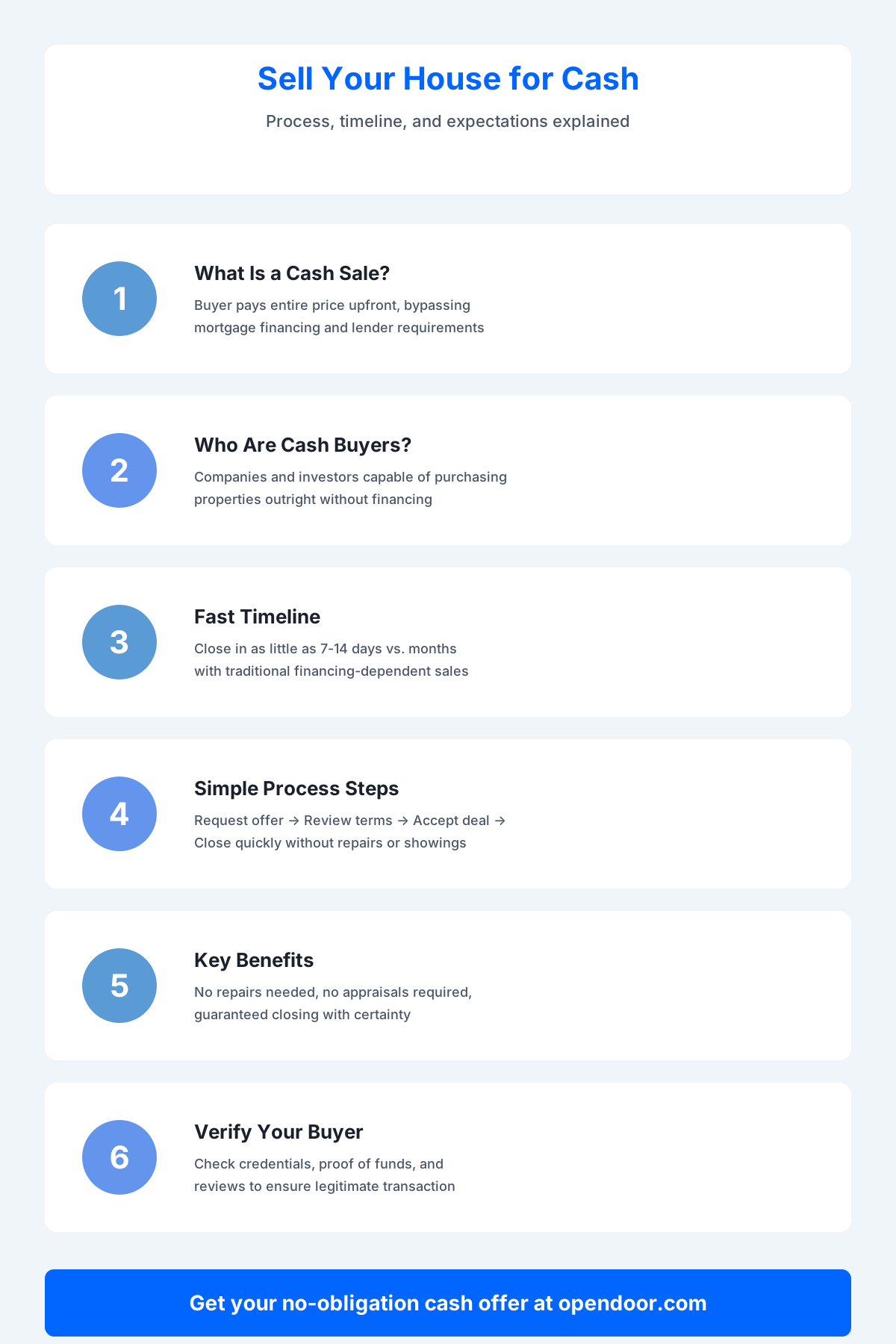
Take a cash offer. Opendoor makes an all-cash offer within 24–48 hours and closes in as few as 21 days on a date you choose. Opendoor buys as-is, so you skip repairs, staging, showings, and open houses. The trade-off is direct: the offer is calibrated to a fast, certain close, so it typically lands below what a well-marketed listing would net after 60 days on market. Because debt is compounding at 21%+ every month, that price gap often disappears once you subtract avoided interest.
| Path | Offer to close | Repairs required | Showings | Certainty |
|---|---|---|---|---|
| Traditional listing (agent) | 45–90 days | Usually yes | Yes | Depends on buyer financing |
| Cash offer (Opendoor) | As few as 21 days | No — sold as-is | No | High — no financing contingency |
| For sale by owner | 60–120 days | Usually yes | Yes | Lower — smaller buyer pool |
If you're sitting on deferred maintenance you can't afford to fix, the sell house as is for cash guide covers what "as-is" actually means at closing.
The Rent-vs-Buy-Again Math After You Sell
Before you sign a listing agreement, run five-year total housing cost for both paths — the step Ramsey and U.S. News both hint at but never quantify.
Say your current PITI is $2,400 on a 3.5% mortgage. A comparable rental runs $2,100 today. Rent looks like a $300/month win. But median asking rent has grown 4–5% annually in most markets (Zillow). At 4% growth, $2,100 becomes $2,457 by year five. Your fixed-rate PITI stays flat except for tax and insurance drift.
Five-year rent total (4% growth): $138,900. Five-year PITI total: $144,000. Renting saves $5,100 over five years — before subtracting the equity you would have built via principal paydown ($15K–$25K) and appreciation (typically 3–4%/year).
Rent only wins by a wide margin when the gap is 30%+ below your PITI. Close numbers usually flip in favor of owning by year three.
When Opendoor Is the Right Fit — and When It's Not
Opendoor fits when speed and certainty matter more than the last dollar of price — the position of a seller bleeding 21% APR. The all-cash offer arrives within 24–48 hours, closing lands in as few as 21 days on a date you choose, and there are no repairs, showings, or open houses. The service charge varies by market and property and is shown in your offer — no repair credits negotiated at closing, no listing-agent commission — so what you see in the offer is what you walk with after mortgage payoff.
Opendoor is not the right fit if:
- You have 3–6 months to run a traditional listing and no urgent cash-flow pressure.
- Your mortgage payoff plus the service charge exceeds current market value — you need a short sale.
- Your home is outside Opendoor's eligibility criteria in your market.
Request an offer to see the number in writing. No commitment, and you can walk if the math doesn't work. For an end-to-end view, see sell my house as is fast.