Key Takeaways
- In community-property states (CA, AZ, TX, and 6 others), marital home equity is split 50/50 by default; in the remaining 41 equitable-distribution states, courts divide assets based on each spouse's financial contribution, earning power, and needs (DivorceNet).
- Selling before the divorce is finalized preserves the joint-filer $500,000 capital-gains exclusion under IRC §121; after the decree, each former spouse is limited to $250,000 — a $250,000 difference that directly reduces the federal tax bill on homes with significant appreciation.
- A spouse buyout requires a formal appraisal; each spouse's share equals (appraised value − remaining mortgage balance) ÷ 2 (HomeLight).
- If one spouse refuses to sell, the other can file a partition action — a court-ordered forced sale that adds 6–12 months and $5,000–$20,000 in legal fees (DivorceNet).
- Opendoor's Cash Offer closes in 21–60 days (the seller picks the date) because Opendoor buys the home directly with company funds — no buyer-financing contingency, no coordinated showings, and no dual-signature repair negotiations.
Divorce forces one decision about your biggest shared asset: sell the house, buy out your spouse, or co-own temporarily. Each path carries different tax, timeline, and equity consequences. The right answer depends on your mortgage balance, your state's property-division laws, and how quickly both parties need a clean financial break. This guide covers every option, the exact math behind an equity split, and how to sell your house fast when communication between spouses has broken down.
Your Three Options: Sell, Buyout, or Co-Own
Divorcing homeowners have three paths for the marital home. Each trades off speed, simplicity, and potential equity differently.
Sell and split proceeds. List the home (or accept a cash offer), pay off the mortgage at closing, and divide the remaining equity per the divorce decree. This is the cleanest break because neither spouse retains mortgage liability or property-maintenance obligations. How much it costs to sell a house depends on the sale method — agent commissions, closing costs, and any condition adjustments all reduce net proceeds.
One spouse buys the other out. The buying spouse refinances the mortgage into their name alone and pays the other spouse their share of equity. This works when one spouse qualifies for the mortgage independently and wants to stay — common when children are enrolled in local schools.
Co-own temporarily. Both spouses keep the home jointly, with a pre-set trigger date for a future sale (for example, when the youngest child graduates high school). Co-owning delays the financial break and requires both parties to agree on maintenance, mortgage payments, and eventual sale terms (Zillow). Joint tenants with right of survivorship carry different liability than tenants in common — check your deed type before committing to this path (Zillow).
Before vs. After — When to Sell the House During Divorce
Timing changes your tax bill and your negotiating position.
Selling before the decree is finalized preserves the joint-filer $500,000 capital-gains exclusion under IRC §121. For a home purchased at $300,000 that sells at $600,000, the full $300,000 gain is excluded from federal taxes. After the decree, each former spouse's exclusion drops to $250,000 — meaning $50,000 of that same $300,000 gain becomes taxable at the applicable capital-gains rate. At the 15% long-term rate, that is $7,500 in additional federal tax. Both spouses must sign the listing agreement and purchase contract when both names are on the deed (DivorceNet).
Selling after the decree gives each spouse independent control over their share. The risk: market shifts between filing and selling increase or decrease equity unpredictably, and post-decree disputes about listing price or repairs have no built-in mediator. The average time to sell a house on the open market adds months to an already extended process.
The trade-off: Selling before the decree is faster and more tax-efficient, but requires cooperation during an adversarial process. Selling after gives independence but shrinks the exclusion and extends the timeline.
How to Split Home Equity and Sale Proceeds Fairly
Equity equals the home's current market value minus the remaining mortgage balance. Here is the math for a $450,000 home with a $200,000 mortgage:
| Item | Amount |
|---|---|
| Sale price | $450,000 |
| Mortgage payoff | −$200,000 |
| Closing costs and seller fees (agent commissions + title + transfer taxes, 8–10% of sale price per NAR) | −$36,000 to −$45,000 |
| Net proceeds | $205,000–$214,000 |
| Each spouse's share (50/50 community-property split) | $102,500–$107,000 |
Opendoor's Cash Offer carries a service fee that varies by market and property and is shown on the Cash Offer page — replacing the traditional 5–6% agent commission — and the service charge and any condition adjustment are listed before the seller commits. Sellers see exact net proceeds upfront because Opendoor's pricing is based on 100+ comparable sales in the home's ZIP code, not negotiation.
In equitable-distribution states (41 of 50), courts divide proceeds based on each spouse's financial contribution, length of marriage, earning potential, and custodial responsibilities — not a flat 50/50 (DivorceNet). The divorce decree or settlement agreement dictates the split, and the title company disburses funds directly to each spouse at closing (DivorceNet).
Buyout vs. Sell — Choosing the Right Path
A buyout keeps one spouse in the home. The buying spouse pays the other their share of equity and refinances the mortgage into their name only, which removes the departing spouse from mortgage liability (HomeLight).
Buyout formula: (appraised value − mortgage balance) ÷ 2 = departing spouse's payout (HomeLight). For a home appraised at $450,000 with a $200,000 balance: ($450,000 − $200,000) ÷ 2 = $125,000.
The buying spouse must qualify for refinancing alone — lenders require a debt-to-income ratio below 43% and sufficient credit history (Bankrate). If the buying spouse does not qualify, a buyout is not viable, and selling becomes the practical path.
How to value the home: A formal appraisal ($400–$600) provides the most defensible number for court purposes. An automated valuation model (AVM) is faster and cheaper but carries less legal weight. When spouses disagree on value, each hires their own appraiser; if the two appraisals differ by more than 5%, a mediator or the court selects a third.
When One Spouse Refuses to Sell
If both spouses are named on the deed, both must sign to sell. When one refuses, the other has three escalation paths:
- Mediation. A neutral mediator facilitates agreement. Mediation costs $3,000–$7,000 per the American Bar Association's 2024 fee survey and resolves disputes in 1–3 sessions.
- Court order through the divorce proceeding. The divorce judge orders the sale as part of property division — the timeline depends on the court's docket.
- Partition action. A separate lawsuit to force a court-ordered sale. Partition actions add 6–12 months and $5,000–$20,000 in legal fees (DivorceNet). Courts order the sale in the vast majority of partition cases because a house cannot be physically divided between two owners.
A lien placed during divorce proceedings — such as a lis pendens — further complicates the sale by clouding the title. Resolving the lien before listing prevents delays at closing.
Step-by-Step: How to Sell a House During Divorce
Step 1 — Agree on a sale method. Both spouses choose between listing with an agent, selling by owner, or requesting a Cash Offer from a direct buyer. The house selling process follows the same legal steps regardless of marital status — divorce adds coordination, not different requirements.
Step 2 — Get a professional appraisal. An independent appraisal establishes fair market value and protects both spouses from accusations of underpricing.
Step 3 — Sign a listing agreement. Both spouses sign if both are on the deed. Designate a neutral coordinator — an attorney, mediator, or the listing agent — to handle communication if spouses are not speaking (HomeLight).
Step 4 — Manage showings. Coordinate a showing schedule through the neutral coordinator. Both spouses vacate the home during showings to prevent confrontations — a scenario agents report as the most common deal-killer in divorce sales.
Step 5 — Accept an offer and negotiate repairs. Both spouses must agree on the accepted price and any repair requests. Dual-signature requirements on every decision slow this stage compared to a standard sale.
Step 6 — Close. The title company pays off the mortgage from sale proceeds, deducts closing costs, and disburses the remaining equity to each spouse per the divorce decree (DivorceNet). Who pays agent commission is determined by the listing agreement and the divorce settlement.
Step 7 — File taxes. Report the sale on the tax return for the year it closes. If sold before the decree, file jointly to claim the $500,000 exclusion. Review taxes on selling a house for the full breakdown.
How a Cash Offer Simplifies a Divorce Sale
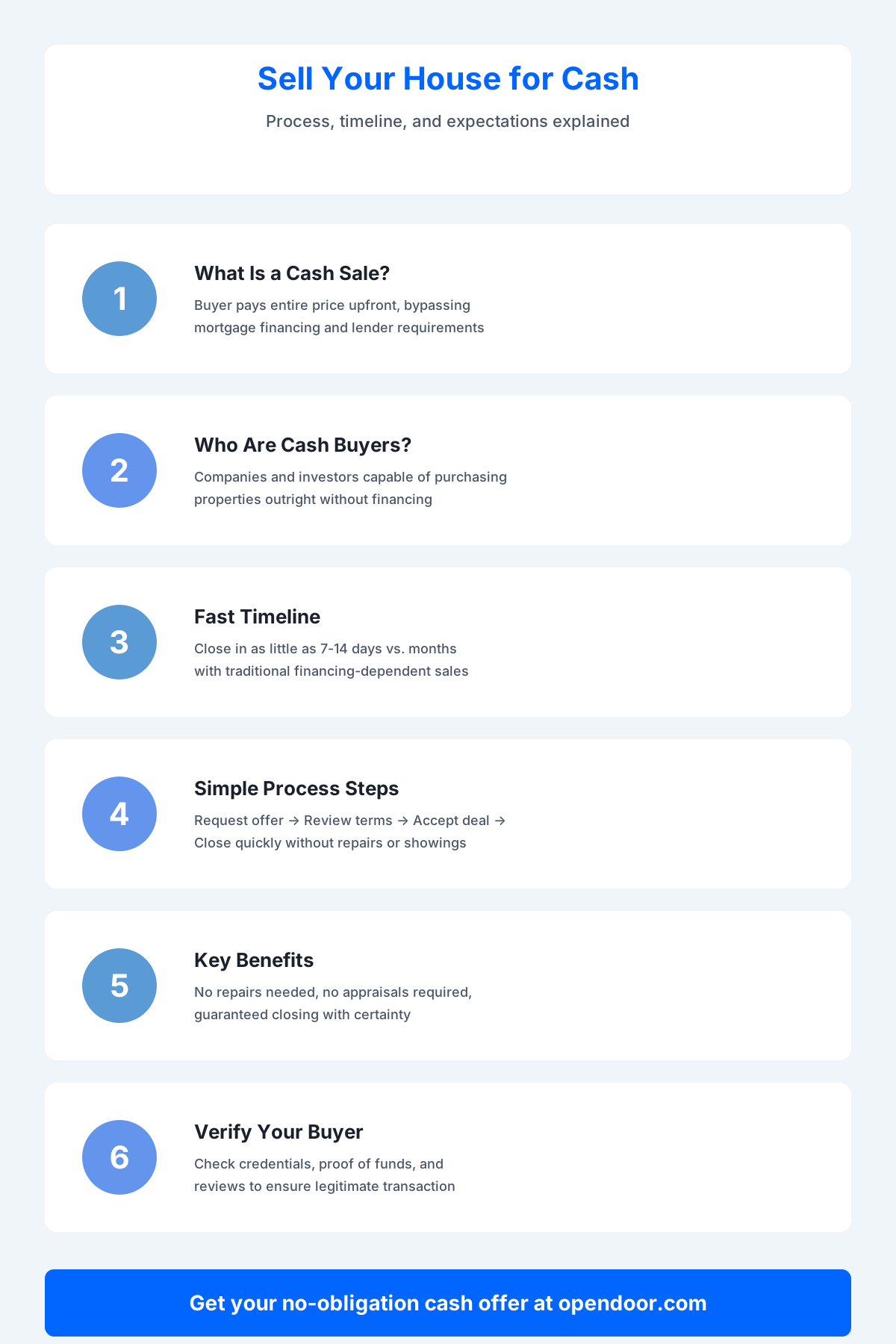
A Cash Offer removes the variables that stall divorce sales: no buyer-financing contingency, no coordinated showings, and no dual-signature repair negotiations. Opendoor closes in 21–60 days — the seller picks the date — because Opendoor buys the home directly with company funds, eliminating the 30–45 day mortgage-approval window that traditional buyers require.
Since 2014, Opendoor has bought 100,000+ homes across 40+ markets. 98% of those offers close on time, and 94% of sellers would recommend Opendoor to a friend. Sellers include military families relocating on short notice, parents buying closer to their children's school district, and divorcing couples who need a guaranteed close date without coordinating showings.
| Step | Traditional listing | Opendoor Cash Offer |
|---|---|---|
| Offer to close | 60–120 days for divorce sales (Redfin) | 21–60 days, seller chooses the date |
| Showings | Required; both spouses coordinate schedules | None — Opendoor buys without showings |
| Repair negotiations | Both spouses sign off on every repair request | No dual-signature repair back-and-forth |
| Buyer financing risk | Sale falls through if the buyer's mortgage is denied | No financing contingency because Opendoor pays cash |
| Proceeds disbursement | Title company splits per decree | Title company splits per decree |
After closing, Opendoor takes full ownership and handles all renovations, maintenance, and relisting. Neither spouse has further obligations.
Who Opendoor's Cash Offer is not built for: Sellers who prioritize maximum sale price over speed and certainty will net more from a traditional listing with 60–90+ days on market, competitive bidding, and full exposure to the buyer pool. If both spouses have 90+ days and can cooperate on showings, repairs, and price negotiations, listing the house on the open market is the higher-ceiling path. Opendoor is built for sellers who need a guaranteed close date, zero showings, and a clean financial break — the exact conditions most divorcing homeowners face.
Request your Cash Offer from Opendoor. No obligation — see your offer and exact net proceeds before you decide.
Top Questions People Ask About Selling a House in Divorce
Should we sell the house before or after the divorce is finalized?
Selling before the decree preserves the $500,000 joint-filer capital-gains exclusion under IRC §121. After the decree, each former spouse is limited to $250,000. Selling before also eliminates post-decree disputes about listing price and market timing. The trade-off: selling before requires both spouses to cooperate on every decision during an adversarial process.
How is the house split in a divorce?
In the 9 community-property states (CA, AZ, TX, NM, NV, ID, WI, LA, WA), marital home equity is split 50/50. In the 41 equitable-distribution states, courts divide equity based on financial contribution, marriage length, earning power, and custodial needs (DivorceNet). The split applies to net proceeds after the mortgage payoff and closing costs.
Can one spouse refuse to sell the house?
Yes. If both names are on the deed, both must sign to sell. When one refuses, the other can pursue mediation, a court order through the divorce proceeding, or a partition action — a lawsuit to force the sale that adds 6–12 months and $5,000–$20,000 in legal fees (DivorceNet).
What happens to the mortgage when we sell?
The title company pays off the remaining mortgage balance from sale proceeds at closing before any equity is distributed. If the home is underwater (the mortgage exceeds the sale price), both spouses share the shortfall; a short sale with lender approval is one resolution (Zillow).
How long does a divorce home sale take?
A traditional listing during a divorce takes 60–120 days from list to close because two decision-makers slow every step — pricing, showing schedules, repair negotiations, and offer acceptance (Redfin). Opendoor's Cash Offer closes in 21–60 days because Opendoor buys with company funds and requires no showings or buyer mortgage approval.
Can I buy out my spouse's share of the house?
Yes, if you qualify to refinance the mortgage into your name alone. The buyout amount equals (appraised value − mortgage balance) ÷ 2 (HomeLight). Lenders require a debt-to-income ratio below 43% for refinancing (Bankrate).
Is selling to a cash buyer the fastest path during a divorce?
A cash sale eliminates the buyer-financing contingency, coordinated showings, and dual-signature repair rounds that extend traditional divorce sales. Opendoor's Cash Offer closes in 21–60 days (seller chooses the date) because Opendoor buys directly — no mortgage lender in the chain. The trade-off is net proceeds: a traditional listing with full market exposure will produce a higher sale price in most markets.
How do you handle showings when spouses aren't speaking?
Designate a neutral third party — the listing agent, a mediator, or an attorney — to coordinate the showing schedule. Both spouses vacate the home during showings (HomeLight). A Cash Offer from Opendoor eliminates showings entirely because Opendoor evaluates the home through comparable-sales data and a walkthrough, not buyer tours.
How are closing costs handled in a divorce sale?
Closing costs — including agent commissions, title fees, and transfer taxes — are deducted from gross proceeds before the equity split. The divorce decree or settlement agreement specifies the allocation; absent a specific provision, costs are deducted pro rata from each spouse's share (NAR).
What's the fairest way to value the home for a buyout?
A formal appraisal ($400–$600) is the most defensible method. When spouses disagree, each hires an independent appraiser; if the two valuations differ by more than 5%, a mediator or the court selects a third. Automated valuation models (AVMs) are faster but carry less legal weight in court proceedings.
Who Opendoor is not for: Divorcing couples whose home is in excellent condition in a hot market, where the difference between a cash offer and traditional sale could be material to an equitable split. Opendoor isn't for sellers who can both agree to wait 60–90 days for an agent-assisted listing — the higher net proceeds may matter more than the time saved. Also not the right fit if your home has unique luxury features that comparable-sales pricing won't fully capture. Consider listing if both parties can coordinate showings and have aligned timing expectations.