Key Takeaways
- Florida follows equitable distribution — courts divide marital assets fairly based on contributions, marriage length, and each spouse's financial circumstances, not an automatic 50/50 split.
- Both spouses must agree to sell the marital home, or one spouse can petition for a court-ordered partition sale to force the transaction.
- Married couples filing jointly can exclude up to $500,000 in capital gains on a primary residence; that drops to $250,000 per person after the divorce is final.
- Selling before the divorce is finalized converts the home into liquid proceeds, which simplifies equitable distribution and eliminates shared mortgage liability.
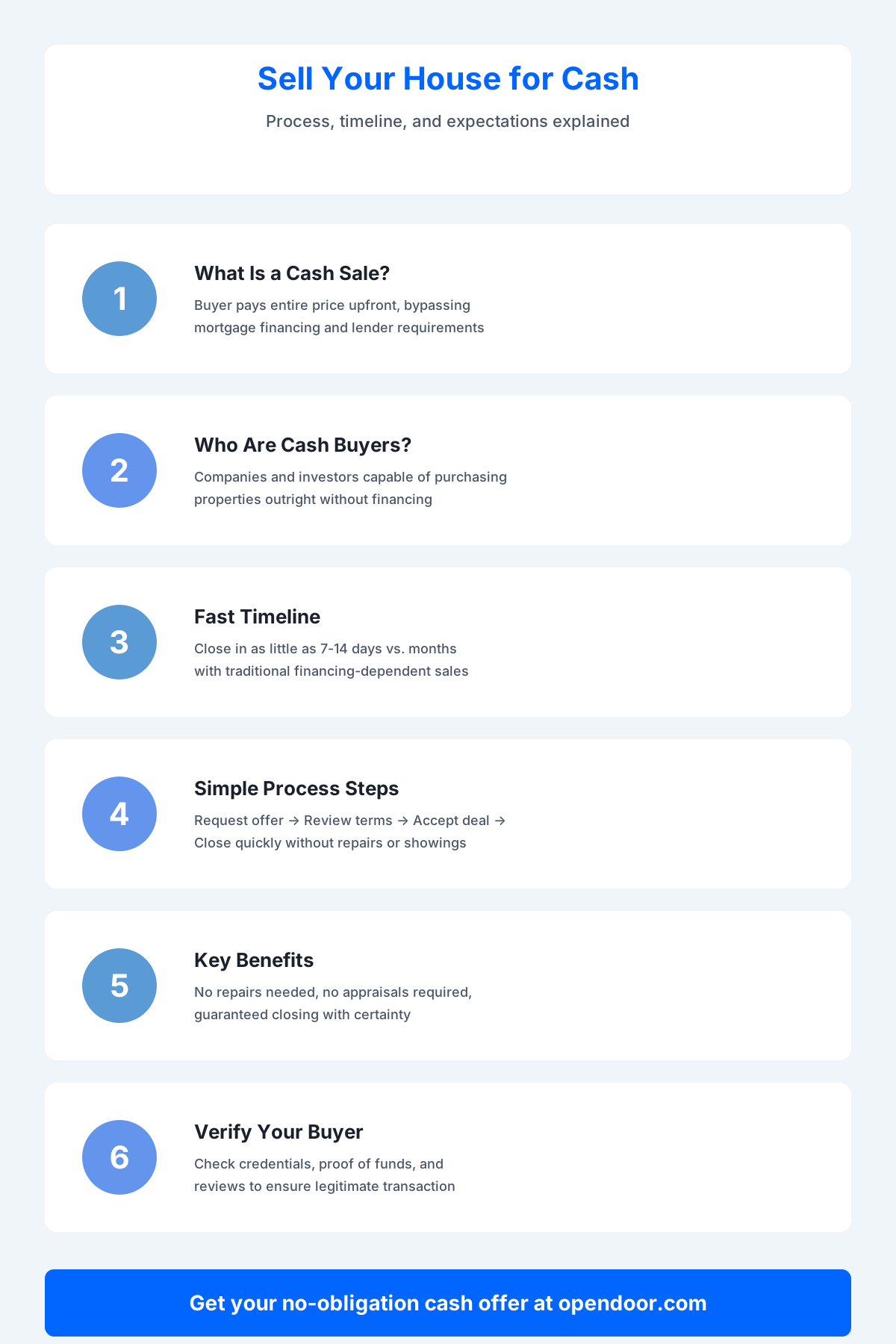
- A cash offer can close in as few as 14 days, removing the multi-month listing period that delays divorce settlement.
Yes, you can sell your house during a divorce in Florida — and in many cases, selling before the decree is finalized is the cleanest path to dividing your largest shared asset. Florida is an equitable-distribution state, not a community-property state, which means a court divides marital property fairly based on each spouse's circumstances rather than splitting it 50/50 automatically. If you need to sell your house during a divorce in Florida, understanding the state-specific rules around property division, homestead protections, and tax timing will shape every decision you make. This guide covers Florida's property-division law, your three selling options, how proceeds are split, and the tax implications of selling before or after the divorce is final.
How Florida's Equitable-Distribution Law Affects Your Home Sale
Florida is one of 41 equitable-distribution states — not a community-property state like California or Texas. Under Fla. Stat. § 61.075, a court divides marital assets fairly, weighing factors that include:
- Each spouse's financial and non-financial contribution to the marriage
- The duration of the marriage
- Each spouse's economic circumstances after the divorce
- Whether either spouse intentionally wasted or depleted marital assets
- Whether either spouse interrupted a career or education to support the household
"Fairly" does not mean "equally." A court can award 60/40 or even 70/30 splits depending on the circumstances. The marital home — often the single largest asset — is subject to these same rules.
What counts as marital property. A home purchased during the marriage with marital funds is marital property regardless of whose name is on the deed. A home one spouse owned before the marriage can become partially marital property if marital funds paid the mortgage, funded renovations, or increased its value. For a broader overview of selling a house during divorce, including how other states handle property division, Opendoor's national guide covers the full picture.
Do Both Spouses Have to Agree to Sell?
If both spouses are on the deed, both must sign the sales contract. One spouse cannot unilaterally list or sell the marital home without the other's written consent.
When one spouse refuses. If negotiation stalls, the other spouse has two paths:
- Petition the divorce court. During active divorce proceedings, either party can ask the court to order the sale of the marital home as part of the equitable-distribution process under Fla. Stat. § 61.075.
- File a partition action. Under Fla. Stat. § 64.041, a co-owner can file a separate lawsuit to force the sale of jointly owned property. A court-appointed commissioner oversees the sale, and the proceeds are divided according to each party's ownership interest. Partition actions add legal costs — attorney fees and court costs — so they work best as a last resort.
When one spouse refuses to cooperate with showings. If the home is listed and one spouse blocks access to potential buyers, the other can petition the court for an order requiring cooperation. This is another reason a cash offer — which requires no showings — can serve as a practical tiebreaker when spouses disagree on the listing process.
When to Sell — Before, During, or After the Divorce Is Final
The timing of your sale affects taxes, mortgage liability, and the complexity of dividing proceeds. Here is how each window compares:
| Timing | Tax exclusion | Mortgage liability | Division complexity |
|---|---|---|---|
| Before filing | $500,000 (married filing jointly, IRS Publication 523) | Ends at closing for both spouses | Lowest — proceeds become cash, split per agreement |
| During proceedings | $500,000 if sold in the same tax year spouses file jointly | Ends at closing | Low — court can incorporate sale proceeds directly into the decree |
| After divorce is final | $250,000 per person (IRS Publication 523) | Continues until sold or refinanced — both spouses remain liable | Highest — requires post-decree coordination between ex-spouses |
The strongest case for selling early. Converting the home to cash before the decree is finalized gives both parties a clear financial position, eliminates the shared mortgage payment during a period when household budgets are already strained, and preserves the higher capital-gains exclusion. It also removes the risk of one spouse neglecting maintenance or payments on a property they no longer live in.
The case for waiting. If the local market favors patience, or if one spouse needs time to secure alternative housing, selling after the divorce can provide breathing room. The trade-off: shared mortgage liability continues, and the capital-gains exclusion drops. For sellers weighing whether to sell and buy a house at the same time, the timing question gets more complex.
How Florida's Homestead Exemption Interacts with a Divorce Sale
Florida's homestead exemption, established in Article X, § 4 of the Florida Constitution, provides two protections for a primary residence:
- Creditor protection. The homestead is shielded from forced sale by most creditors (excluding mortgage lenders, property-tax authorities, and mechanics' lien holders).
- Property-tax cap. The Save Our Homes amendment limits annual assessed-value increases to 3% for homesteaded properties.
What the exemption does not do. The homestead exemption does not prevent a divorce-ordered sale. A family court retains full authority to order the sale of the marital home as part of equitable distribution. The exemption protects the home from outside creditors — not from the court dividing marital assets.
What happens to the tax cap. If one spouse retains the home, that spouse keeps the existing homestead assessment. If the home is sold, the assessment resets for the new owner at full market value. This distinction matters when one spouse considers a buyout: keeping the home preserves the capped assessment, which can represent thousands of dollars in annual property-tax savings depending on how long the homestead has been in place.
Selling Options — Listing, Buyout, or Cash Offer
You have three paths to resolve the marital home. Each carries different timelines, costs, and levels of cooperation required between spouses.
Option 1: List with an agent. A traditional listing offers the highest potential sale price because it exposes the home to the broadest buyer pool. The trade-off: the average time to sell a house runs 55–70 days from listing to accepted offer, plus 30–45 days to close — a total of 85–115 days according to NAR's 2025 Profile of Home Buyers and Sellers. That timeline extends the period of shared financial responsibility and requires both spouses to cooperate on showings, repairs, and counter-offers. Agent commissions and closing fees sellers pay reduce net proceeds. For a full breakdown, see this step-by-step guide to selling your house.
Option 2: One spouse buys out the other. The keeping spouse pays the exiting spouse their share of equity — determined by the equitable-distribution agreement — and refinances the mortgage into their name alone. This path works when one spouse has enough income to qualify for a new mortgage independently. If the keeping spouse cannot refinance, both names stay on the loan, leaving the exiting spouse exposed to missed-payment risk.
Option 3: Accept a cash offer. A company like Opendoor makes a cash offer based on comparable sales data for the home's ZIP code and the property's specific features. Cash offers remove buyer-financing contingencies and eliminate the need for showings — both significant advantages when spouses are in conflict. Opendoor closes in as few as 21 days, and sellers choose their close date. The trade-off: a cash offer reflects a market-competitive price minus Opendoor's service fee (varies by market and property and is shown up front in your offer) and any condition adjustments, so net proceeds are lower than a best-case traditional listing. For sellers prioritizing speed and certainty over maximum price, the math often works — especially when carrying costs (mortgage, insurance, taxes) accumulate during a prolonged listing period.
| Factor | Traditional listing | Spouse buyout | Opendoor Cash Offer |
|---|---|---|---|
| Timeline | 85–115 days | 30–60 days (refinance dependent) | 21–60 days (seller chooses) |
| Showings required | Yes | No | No |
| Both spouses must cooperate on sale terms | Yes — counter-offers, repairs, scheduling | No — one spouse exits | Minimal — both sign, Opendoor handles the rest |
| Service fee / commission | 5–6% agent commission | Appraisal + refinance costs | Service fee that varies by market and property + condition adjustments |
| Buyer-financing risk | Yes — deal can fall through | N/A | None — cash, no contingency |
| Highest potential price | Yes | Depends on appraisal | Market-competitive, net of fees and repairs |
To understand the full breakdown of how selling to Opendoor compares to a traditional home sale, including repair costs and net-proceeds math, see Opendoor's comparison guide. You can also explore how to sell your house for cash with Opendoor for a full walkthrough of the process.
How Sale Proceeds Are Divided in a Florida Divorce
Once the home sells, proceeds are distributed in a specific order:
- Mortgage payoff. The remaining loan balance is paid first. If both spouses are on the mortgage, this clears the shared liability for both parties. If one spouse brought a lien or encumbrance into the sale, that gets resolved at closing as well.
- Closing costs. Agent commissions (if listed), title insurance, transfer taxes, recording fees, and any service fees come off the top. Understanding how much it costs to sell a house before you list prevents surprises at the closing table.
- Equity split. The remaining proceeds are divided per the divorce settlement agreement or court order.
Protecting yourself on price. Both spouses should obtain a pre-sale appraisal to establish fair market value before agreeing to a sale price. A residential appraisal costs $300–$600 and protects against accusations from either side that the home was sold below market value. If you sell to a cash buyer, having an independent appraisal in hand gives both parties confidence that the offer is reasonable relative to the local market.
Handling the mortgage when one spouse exits. If one spouse is keeping the home (buyout scenario), the exiting spouse should insist on a refinance, not just a quitclaim deed. A quitclaim removes the exiting spouse from the deed but does not remove them from the mortgage — meaning they remain financially liable if the keeping spouse misses payments.
Tax Implications of Selling the Marital Home During a Florida Divorce
Federal tax rules determine how much of your home-sale profit is taxable. Florida has no state income tax, so the federal rules are the only ones that apply.
The primary-residence exclusion. Under IRS Publication 523, sellers who have owned and lived in the home for at least 2 of the last 5 years can exclude capital gains from their taxable income:
- Married filing jointly: up to $500,000 excluded
- Single or filing separately (post-divorce): up to $250,000 excluded per person
Why timing matters. Your filing status for the tax year of the sale determines which threshold applies. If the home sells and the divorce is finalized in the same calendar year, your filing status depends on whether the decree was entered before December 31. Selling while still legally married — and filing jointly for that tax year — preserves the $500,000 exclusion.
For homes with significant appreciation, that $250,000 difference in excludable gains represents real tax dollars. A home purchased for $200,000 that sells for $650,000 produces $450,000 in gain. A married couple filing jointly excludes all of it. Two ex-spouses filing separately each exclude $225,000 — and each owes capital-gains tax on zero. But if the gain were $550,000, each ex-spouse would owe tax on $25,000 of gain that a joint filing would have fully excluded. For more strategies, see Opendoor's guide on how to avoid capital gains tax when selling a house.
The 2-of-5-year ownership test. Both spouses must meet the residency requirement independently under IRS Topic No. 701. If one spouse moved out more than 3 years before the sale, that spouse no longer qualifies for the exclusion on their share — unless a divorce decree or separation agreement grants them a right to use the property, which the IRS treats as constructive residency.
Top Questions People Ask About Selling a House During Divorce in Florida
Is Florida a community-property state for the marital home? No. Florida is an equitable-distribution state. Under Fla. Stat. § 61.075, courts divide marital property fairly — weighing contributions, marriage length, and each spouse's economic circumstances — rather than splitting everything 50/50. Nine states follow community-property rules (Arizona, California, Idaho, Louisiana, Nevada, New Mexico, Texas, Washington, and Wisconsin). Florida is not one of them.
Can one spouse force the sale of a house during divorce in Florida? Yes. If one spouse refuses to sell, the other can petition the divorce court for a sale order as part of equitable distribution. Outside of divorce proceedings, a co-owner can file a partition action under Fla. Stat. § 64.041 to force a court-supervised sale. Partition actions add attorney fees and court costs, so they function best as a last resort when negotiation has failed.
Can we sell the house before the divorce is filed in Florida? Yes. No law requires you to wait until divorce papers are filed. Selling before filing converts the home into cash, which is easier to divide during the divorce. It also preserves the $500,000 married-filing-jointly capital-gains exclusion (IRS Publication 523). Both spouses must agree and sign the sales contract.
How are home sale proceeds split in a Florida divorce? The mortgage balance and closing costs come off the top. Remaining equity is divided per the divorce settlement agreement or court order. The split is not automatic 50/50 — it follows Florida's equitable-distribution factors. Both spouses should obtain independent appraisals ($300–$600 each) to verify the sale price reflects fair market value.
What if only one spouse is on the deed but both are on the mortgage? The spouse on the deed holds legal title and can sell the property, but if the home was purchased during the marriage with marital funds, the non-titled spouse still has an equitable interest under Florida law. The non-titled spouse can file a lis pendens — a public notice of pending litigation — to prevent the titled spouse from selling without addressing their claim. Both spouses remain liable on the mortgage until the loan is paid off or refinanced, regardless of whose name is on the deed.
What about the homestead exemption — does it block a divorce sale? No. Florida's homestead exemption protects the primary residence from forced sale by most outside creditors, but it does not prevent a family court from ordering the sale of the home as part of divorce proceedings. The exemption is a shield against creditors, not against the equitable-distribution process.
Does a Florida divorce decree need to address the marital home? Yes. If the marital home is not addressed in the divorce settlement or final judgment, either spouse can petition the court to reopen the property-division issue. Leaving the home out of the decree creates legal and financial uncertainty — shared mortgage liability continues, maintenance responsibilities remain ambiguous, and neither party has a clear right to sell. Every divorce decree should explicitly state what happens to the home.
Can a cash offer speed up the sale during divorce? Yes. A cash offer removes two of the largest delays in a divorce-related home sale: the listing period (which runs 55–70 days on average before an accepted offer, per NAR data) and buyer-financing contingencies (which add 30–45 days and carry the risk of deal collapse). Opendoor's Cash Offer closes in as few as 21 days, and both spouses receive a clear net-proceeds number upfront — eliminating the counter-offer negotiations that re-ignite conflict between divorcing parties.
What happens to the house after I sell to Opendoor? Opendoor takes ownership at closing and handles all repairs, listing, and resale. You do not need to coordinate post-sale maintenance or hold open houses. For details on the handoff, see what happens after you sell to Opendoor.
How do I handle the emotional weight of selling the family home during a divorce? Selling the home is one of the most emotionally charged parts of divorce. Acknowledge the weight of the decision, then separate the financial analysis from the emotional attachment. A pre-sale appraisal gives you an objective value anchor, and choosing a clear deadline — whether it is a listing period or a cash-offer close date — prevents the sale from dragging out alongside the divorce. Opendoor's guide on the emotional impact of selling your home covers coping strategies in depth.
When Opendoor Is Not the Right Fit
Opendoor isn't for every divorce sale. If you have 90 or more days before you need proceeds, a strong local market with low inventory, and both spouses are willing to cooperate on showings and counter-offers, a traditional listing with an agent will produce the highest sale price in most cases. Opendoor also isn't the right fit if your home has extensive custom upgrades — pools, additions, high-end finishes — that a comparable-sales-based pricing model does not fully capture. Consider listing if maximizing gross price matters more than speed and certainty. For sellers who need to sell a house fast because the divorce timeline demands it, or when one spouse refuses to cooperate with the traditional process, a cash offer solves the coordination problem because it eliminates showings, buyer contingencies, and the back-and-forth of negotiation entirely.